

Run a speed test at two in the morning and your phone flies. Run the same test at seven in the evening and it crawls. Nothing about your phone, your SIM, or your house changed — so why does mobile internet have rush hours? The answer is sharing. Mobile networks are a shared resource, and like a motorway, they flow freely at night and jam when everyone uses them at once. This guide explains the science of network congestion in simple terms, how to prove it is the cause of your slow daytime speeds, and the practical workarounds that help until capacity improves.
Quick Answer
Mobile internet is fast at night and slow in the day because of network congestion. During the day and evening, thousands of people share the same tower’s limited capacity for streaming, calls, work, and school, so each user gets a smaller share and speeds fall. At night most people are asleep, the tower is nearly empty, and your phone gets almost the whole capacity to itself. Scheduling big downloads for off-peak hours, using Wi-Fi where possible, and 5G where available are the best workarounds.
How a Mobile Tower Shares Its Capacity
A mobile tower (properly called a cell site) has a fixed amount of radio capacity in each of its frequency bands, and a backhaul connection — usually fibre — linking it to the rest of the network. Every connected phone shares both. Think of the radio capacity as the width of a pipe and the backhaul as the pipe’s connection to the reservoir. When ten people are connected, each can draw plenty. When a thousand people connect at peak time and many of them stream video, the same pipe must be divided a thousand ways.
Networks manage this sharing with scheduling software that rapidly rotates resources among users, giving priority according to plan type and network rules. Premium plans and some business plans are often served first during congestion, while budget plans may be deliberately slowed sooner. This is all normal engineering, not a fault, which is why our article on why 4G internet is slow in your area lists congestion as the number one local cause of poor speeds.
What the Daily Pattern Looks Like
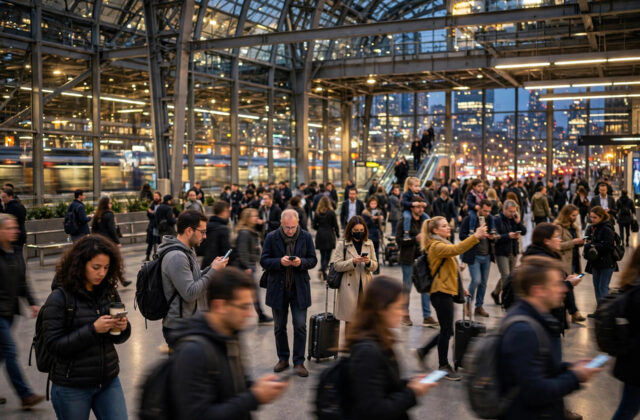
On a typical residential tower, demand follows the rhythm of the neighbourhood. There is a morning rise as people wake and commute, a busy working day, and the biggest peak of all between about 7 pm and 10 pm, when households stream films, game, and video-call at the same time. After midnight, usage collapses, and speeds reach their best. Weekends have their own pattern, with a longer afternoon plateau. If your slow times match the evening peak, congestion is almost certainly your answer, and no phone setting will fully cure it.
Interestingly, the tower’s signal strength does not change at all through this cycle. Your bars stay the same because the signal is constant; it is the sharing that changes. This is why judging a connection by signal bars alone is so misleading. Ofcom’s research into broadband and mobile performance, published through its connected nations and performance reports, documents these peak-time effects across UK networks.
How to Prove Congestion Is Your Problem
- Test in the same spot at set times. Stand in one place and run a speed test at 7 am, 1 pm, 8 pm, and after midnight. Save the results.
- Compare the pattern. If evening speeds are a small fraction of overnight speeds in the same spot, that is textbook congestion. If speeds are equally poor at 3 am, your problem is coverage, band, or plan instead.
- Check latency too. Congestion raises delay (ping) as well as lowering speed. Games and calls suffer from the delay even when raw speed looks acceptable.
- Test a different location. If a nearby town centre tower is fast at 8 pm, the issue is your local cell’s load or capacity, not your phone or account.
- Ask neighbours on your network. Shared pain at the same hours confirms a local capacity issue.
Workarounds That Actually Help
- Schedule heavy downloads overnight. Set phones, consoles, and laptops to update and back up in the small hours when the tower is empty. Cloud photos and game downloads finish in minutes instead of hours.
- Move important work off-peak. A big upload at 9 am instead of 8 pm can be several times faster.
- Use home broadband and Wi-Fi calling at peak times. If your mobile is only a backup, let fixed broadband carry the evening load.
- Try 5G if your area has it. 5G adds large amounts of new capacity, so 5G cells are often uncongested even when 4G next door is jammed.
- Test another network. Congestion is specific to a provider and a tower. A rival network’s mast may serve your street with far fewer users.
- Lower streaming quality at peak times. Standard definition uses far less of the shared pipe and still looks fine on a phone screen.
Why Networks Do Not Just Fix It
Capacity upgrades are constant but invisible: adding bands to a mast, installing new sectors, upgrading backhaul, or building a new site all take planning permission, equipment, and money. Networks invest where usage data justifies it, and reporting chronic peak-time problems does feed their planning. There is also simple economics: building every tower for the absolute peak hour would leave most of that capacity idle for twenty hours a day. The long-term direction is clear, though — each generation, especially 5G with its wider channels, exists largely to push the congestion ceiling higher.
Common Mistakes to Avoid
- Testing once at 8 pm and concluding your phone is broken. Time-of-day comparison is the whole diagnosis.
- Buying a signal booster for a congestion problem. A booster improves signal, not capacity. If your signal is already strong, it changes nothing at peak time.
- Running repeated speed tests at peak time. Each test consumes a big slice of the shared resource (and your allowance) while proving the same point.
- Assuming unlimited means unthrottled. Many plans deprioritise heavy users precisely during congestion, making your evenings slower than your neighbours’.
Events and Emergencies: The Extreme Peaks
The daily peak is gentle compared with what happens around a stadium on match day, a festival, or a major incident, when tens of thousands of phones land on a handful of cells at once. Speeds can fall to near zero even with full signal, messages queue, and uploads of photos and videos — the heaviest thing a crowd does — compete with everyone trying to find their friends. Networks deploy temporary cells for big planned events, but spontaneous gatherings overwhelm any plan. The traveller’s tactics are simple: download tickets, maps, and meeting arrangements before you arrive, agree a meeting point in case messages lag, and send photos later from Wi-Fi rather than fighting the crowd’s bandwidth in the moment.
Conclusion
Fast nights and slow days are the signature of a shared network doing exactly what physics and economics predict. Prove it with timed tests, then work with the rhythm instead of against it: schedule the heavy jobs for quiet hours, lean on Wi-Fi or 5G in the evening peak, and keep reporting chronic congestion so your mast climbs the upgrade list.
Frequently Asked Questions
Why is the evening slower than the working day?
Because leisure streaming is heavier than daytime work traffic. When a whole neighbourhood watches video at once, demand peaks higher than during office hours, even though more people are awake in the day.
Does congestion affect calls as well as data?
It can. On very busy cells, calls may take longer to connect, and VoLTE quality can dip. Networks prioritise voice, so calls usually survive better than data, but they are not immune.
Will a better phone fix peak-time slowness?
Only slightly, and only if your old phone lacked modern features like carrier aggregation or 5G. The bottleneck is the shared tower capacity, not your handset.
Why is my friend’s network fast at the same time mine is slow?
Different networks have different towers, user numbers, and capacity on your street. Congestion is local to each network’s cell, so experiences vary by provider even in the same house.
Is there a setting that gives me priority?
No consumer setting changes your priority on the tower. Priority is decided by the network based on your plan type. The only real levers are timing, location, technology (5G), and provider choice.


Leave a Reply