
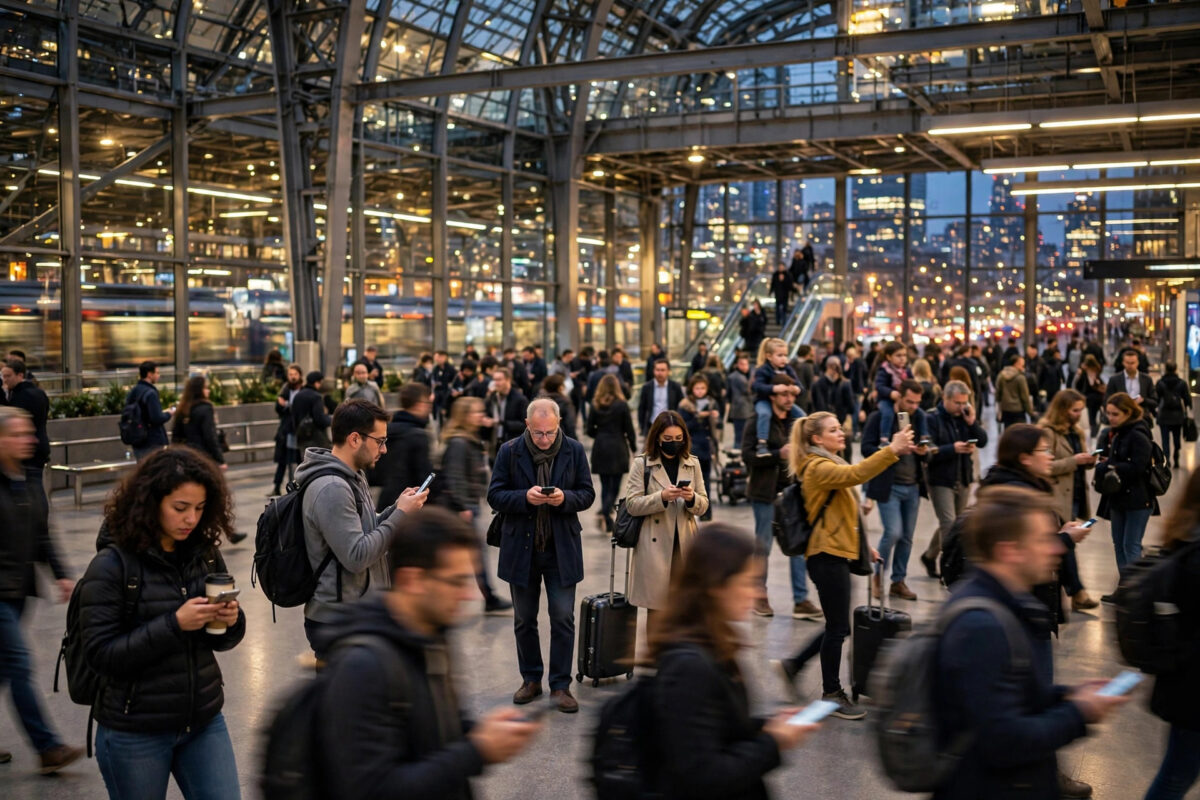
Your speed test at breakfast shows 120 Mbps. At 8 p.m., the same spot on the same sofa shows 6 Mbps and a buffering wheel. Your phone has not changed and the mast has not moved — what changed is everyone else coming home and picking up their phones. That is network congestion: too many users sharing too little capacity, and it is the single most common cause of slow mobile data in 2026.
Quick Answer
Network congestion happens when more people connect to a mobile mast (or one of its sectors) than its capacity can serve at full speed, so the available bandwidth is shared out and everyone’s data slows down. It peaks in the evening, at events, and in busy transport hubs, and typically eases late at night. Strong signal bars do not protect you — congestion is about load, not signal strength.
How Mobile Capacity Actually Works
A mobile mast divides its coverage into sectors, each with a fixed amount of radio capacity determined by the spectrum (frequency bands) the network has deployed there. Think of it as lanes on a road: the mast can serve only so much total traffic per second, and every active user takes a share. At 6 a.m., a handful of users each get a huge share and blistering speeds. At 8 p.m., hundreds of phones stream video simultaneously through the same sectors — the total capacity is similar, but your slice shrinks dramatically.
Networks manage this sharing with schedulers that divide capacity fairly-ish among active users, prioritising small interactive traffic and, on some tariffs, prioritising premium customers over budget ones. That last point is why two people on the same mast but different plans can see different speeds at the same moment — and why your slowdown may look a lot like the throttling described in our guide on why data speed is limited after a fair usage cap, even though the underlying cause is different.
The Congestion Timetable
- Weekday evenings (roughly 7–11 p.m.): the classic peak — everyone streams at home, and in areas with weak fixed broadband, phones carry the load.
- Events: stadiums, festivals, concerts, and matches squeeze tens of thousands of phones into a few sectors.
- Transport peaks: commuter trains and stations concentrate users twice a day.
- Tourist seasons and holidays: coastal and rural towns can see their population — and network load — multiply for weeks.
- Emergencies and big news moments: sudden spikes of calls and refreshes can saturate even well-built networks briefly.
Regulators and measurement firms publish this pattern openly; Opensignal’s consumer experience reports, built from billions of real-world measurements, consistently show speeds dipping at peak hours across networks worldwide.
How to Tell Congestion From Other Problems
- Time pattern: slow at predictable busy hours, fast overnight and early morning. That rhythm is congestion’s signature.
- Signal is strong: full bars but slow data means capacity, not coverage, is the bottleneck.
- Upload often holds up better than download in the evening, because everyone is downloading streams while few upload.
- Neighbours on the same network report the same thing at the same times; a different network in the same spot may be fine.
- Your speed recovers instantly when you move a street or two — you have joined a different, quieter sector.
What You Can Do About It
- Shift heavy activity off-peak: schedule big downloads, cloud backups, and game updates for overnight, when the mast is empty.
- Use home Wi-Fi in the evening. Your broadband does not share capacity with the whole street’s phones in the same way (though fixed networks have milder peak effects of their own).
- Try a different band: some phones let you prefer 4G over a congested local 5G band or vice versa; occasionally the quieter technology wins.
- Consider your network choice: if evenings are unusable month after month, a rival network may have more capacity in your area — test with a prepaid SIM before switching.
- Lower your streaming quality at peak times: standard definition needs a fraction of the bandwidth and often plays smoothly when HD stutters.
What Networks Do About It
Networks relieve congestion by adding spectrum (new bands at a mast), splitting sectors, building additional masts, and offloading traffic to Wi-Fi. These upgrades happen continuously but unevenly — one neighbourhood gets relief while another waits. Persistent severe congestion in a growing area is worth reporting: networks genuinely use complaint and usage data to prioritise their build programmes.
Common Mistakes to Avoid
- Judging a network by one peak-hour test. Measure across a day before concluding anything.
- Buying a signal booster for a congestion problem. Boosters fix weak signal; they amplify capacity problems just as faithfully.
- Assuming full bars mean fast data should follow. Bars measure signal strength only, not how many people are sharing it.
- Blaming your phone and factory-resetting it, when the whole street is slow at the same time.
Congestion vs Weak Coverage: A Quick Diagnostic
Because the remedies differ completely, it is worth separating the two problems cleanly. Weak coverage shows weak signal readings (one or two bars, or readings below about −110 dBm in your phone’s field test screen), is slow at ALL hours, improves dramatically near windows or outdoors, and affects one building or dip in the road more than the whole town. Congestion shows strong signal readings, follows the clock rather than the map, hits the whole neighbourhood on the same network together, and vanishes in the small hours. Run one test at 8 p.m. and one at 7 a.m. from the same chair: a huge gap between them is a congestion diagnosis you can trust, while identical slowness points back to coverage — and to the very different fixes for it.
Why Congestion Will Keep Changing Shape
Demand never sits still: video quality climbs, homes quietly adopt connected cameras and cars, and villages that lose fixed broadband options lean harder on mobile. Networks respond in waves — a newly upgraded mast can make your street feel transformed for two years before growth catches up again. That is why the honest advice in this area always has a date on it: re-test your area’s networks at each contract renewal, because the congestion map of your town is being redrawn continuously.
Conclusion
Network congestion is simply rush hour on a shared road: the mast’s capacity is finite, the evening crowd is not, and your speed is your slice of the total. Recognise its timetable, move heavy tasks to quiet hours, lean on Wi-Fi in the evenings, and — if your area is chronically saturated — let a prepaid SIM test tell you whether another network’s road is emptier. The fix is rarely a new phone; it is timing and choosing the right network for your street.
Frequently Asked Questions
Why is my data slow at night but fast in the morning?
Because the evening is when the most people use the same mast simultaneously — streaming, gaming, and scrolling after work and school. By morning, most have left for the day or are still asleep, so the same capacity is shared between far fewer users.
Can congestion affect calls as well as data?
In extreme cases, yes — a saturated sector can delay call setup or push calls to older 2G/3G layers with lower quality. Networks prioritise voice where they can, so data usually suffers first and worst.
Does 5G solve network congestion?
It raises total capacity substantially, especially with wide mid-band channels, so a 5G mast serves far more users at speed than a 4G one. But where 5G adoption is heavy and the deployment thin, 5G sectors can congest too — capacity always chases demand.
Why is my friend on another network fast while mine is slow in the same place?
Each network has its own masts, spectrum, and customer numbers in that spot. Your network’s sector may be saturated while theirs has spare capacity. This is the strongest argument for testing rival networks with prepaid SIMs before a long contract.
Is deprioritisation the same as congestion?
They are related but different. Congestion is the physical reality of a busy mast. Deprioritisation is a policy: during congestion, the network serves some customers (usually premium tariffs) before others (often budget brands). You feel deprioritisation only when congestion exists.



Leave a Reply