
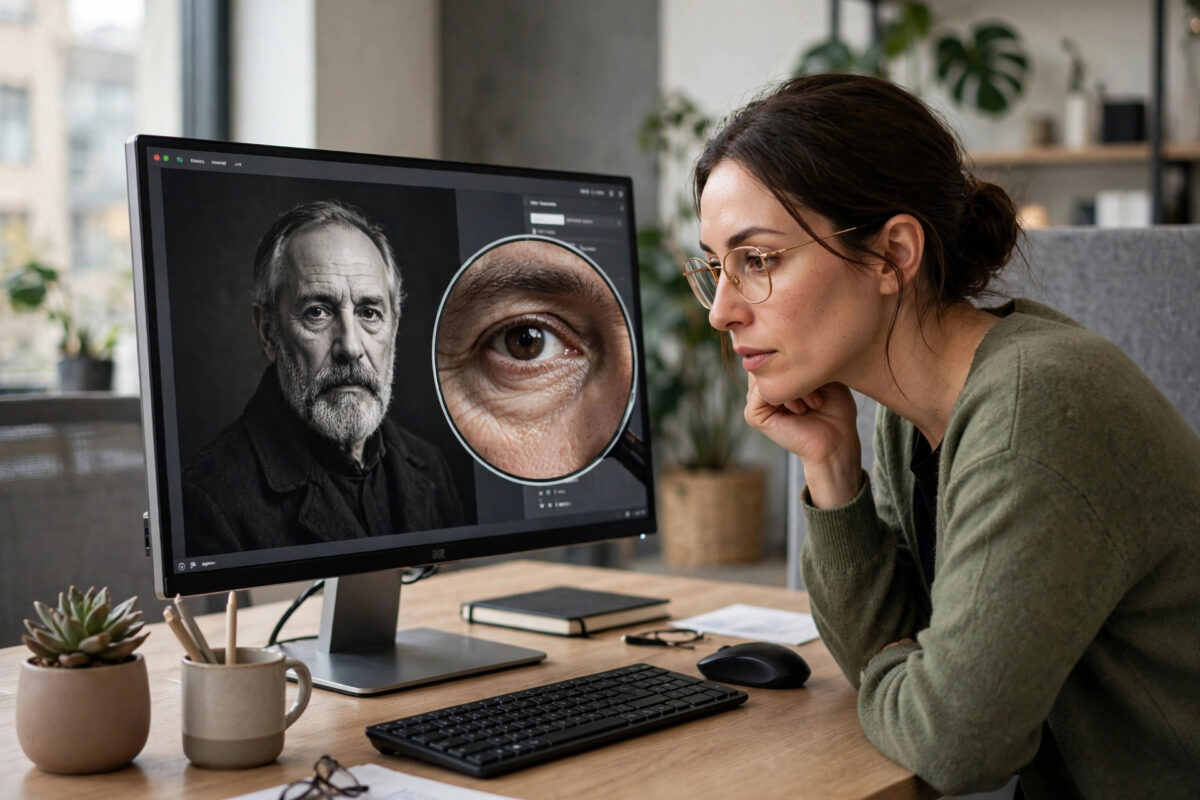
A flawless portrait with strange hands. A breaking-news image that no photographer is credited for. A product photo that looks perfect until you read the packaging text. AI-generated images are now good enough to fool a casual glance, and they circulate everywhere — social feeds, news shares, adverts, and marketplace listings. Knowing how to question an image is becoming a basic digital literacy skill, not a niche trick for experts.
The honest starting point is that no single check is foolproof. Modern generators have fixed many early flaws, professional fakes combine AI with real photography and editing, and heavy compression on social platforms destroys evidence. But most AI images still leave traces, and a calm, layered check — visual clues, context, reverse searching, and detection tools — catches the large majority of them.
This guide gives you that layered method: the visual signs worth examining first, the contextual questions that often settle the matter faster than pixels do, and how to use free verification tools without over-trusting their scores.
Quick Answer
To check if a photo was created by AI, zoom in on hands, text, jewellery, and backgrounds for distortions, verify the source and context, run a reverse image search, and use an AI detector as a second opinion. Treat several small clues together as stronger evidence than any one sign.
Why AI Images Are Hard to Spot Now
Early AI images were easy: melted faces, extra fingers, and dreamlike backgrounds gave them away in seconds. Current models are trained to correct exactly those failures, render plausible skin texture and lighting, and imitate specific camera styles, from smartphone snapshots to press photography. Some generators can also copy the look of a real event or a real person’s likeness from reference photos.
At the same time, real photos are increasingly processed. Phones apply computational sharpening, portrait blur, and night-mode blending that can look uncanny in their own right, and social platforms recompress uploads until genuine detail smears. So the task is not hunting for one magic flaw; it is weighing evidence. A strange hand plus an unknown source plus no earlier copies online is a meaningful pattern. One odd shadow alone is not.
Your goal also matters. Deciding whether to share a viral image, buy from a listing, or publish a picture editorially requires more certainty than satisfying curiosity about a profile photo. Match your effort to the stakes.
Visual Signs to Check First
Hands, Faces, and Small Details
Zoom in — really zoom in. Hands remain the most revealing area: extra or fused fingers, nails that merge into skin, and jewellery that changes shape between fingers. Check ears, teeth, and glasses where they meet the face; AI often renders them asymmetrically or with soft, painterly edges. Hair may dissolve into the background at the edges, and skin can look airbrushed in patches while oddly pored in others.
Text, Logos, and Patterns
Generators are notoriously weak at rendered text. Signs, book spines, shirts, packaging, and licence plates often contain near-words: letters that almost form language, especially in the background. Repeating patterns also break down — tiles that change size, bricks that melt, crowd faces that duplicate, or reflections that do not match the object supposedly reflected.
Lighting, Shadows, and Physics
Look for light that disagrees with itself: faces lit from the left while shadows fall the other way, multiple catchlights in eyes pointing different directions, or objects casting no shadow at all. Backgrounds deserve equal attention. Door frames bend, shelves hold impossible objects, and distant people blur into mannequin-like figures. Individually these can occur in real photos through lens distortion; several together should raise your suspicion sharply.
For a broader framework on checking suspicious media, our technology explainers on AI and online safety cover companion checks for video and audio deepfakes as well.
Step-by-Step: A Practical Verification Workflow
- Pause before you react or share. AI fakes are often designed to provoke emotion — outrage, awe, sympathy. A deliberate pause is your first verification tool.
- Inspect at full size. Open the largest version available and zoom into hands, eyes, text, jewellery, and background edges. Screenshot and enlarge if the platform limits zoom.
- Check the source. Who posted it first? Is the account established with a history of real photography, or new and anonymous? Is there a photographer credit, location, or event detail you can corroborate?
- Run a reverse image search. Upload the image to a reverse search engine. If identical or near-identical images appear from earlier dates or reputable coverage, the photo is likely real — or at least older than claimed. No results at all for a supposedly famous scene is a warning sign.
- Search the story, not just the image. If the photo claims to show a real event, search news coverage of that event. Major incidents are photographed by many people from many angles; a single perfect image with no corroboration deserves scepticism.
- Look for provenance and metadata where available. Some cameras and platforms now attach content credentials that record how an image was made and edited. Absence proves nothing, but a verified capture history is strong positive evidence.
- Run an AI image detector as a second opinion. Use one or two reputable detectors, understanding they estimate probability, not certainty. A high AI score plus visual clues strengthens the case; a score alone settles nothing.
- Decide proportionally. If evidence is mixed and the stakes are low, describe the image as unverified rather than declaring it fake. If stakes are high, do not publish or pay until you have independent confirmation.
Using Detection Tools Wisely
AI detectors analyse statistical patterns in pixels that humans cannot see, and the better ones perform respectably on unedited outputs from major generators. Their limits matter just as much: cropping, resizing, screenshots, filters, and printing-then-photographing an image can all defeat them, and they produce both false positives on real art and photography and false negatives on heavily edited AI work.
Use detectors the way doctors use a single test — as one input among several. If a detector says an image is likely AI, go back and look for the visual and contextual evidence to support that. If it says likely real but your eyes and the source check disagree, trust the combined picture over the score. Never accuse a photographer or seller of fakery based on a detector score alone; that harms real creators and is often wrong.
For standards background, the Content Authenticity Initiative explains how provenance credentials are being built into cameras and editing tools, while Wikipedia’s overview of synthetic media gives useful context on how generation techniques are evolving.
Common Mistakes and Pro Tips
The commonest mistake is single-clue certainty. One merged finger in a low-resolution crowd shot proves very little; compression mangles real hands too. Equally, a flawless image is not automatically real — it may simply be a good generation, a composite, or a real photo of a staged scene. Judge the whole evidence set.
Another mistake is trusting the caption’s confidence. Viral posts present AI images with precise locations, dates, and backstories because specificity feels credible. Treat captions as claims to be checked, not as evidence in themselves. Similarly, beware the reverse error: labelling real disaster or conflict photography as AI because it looks dramatic. That mistake, repeated widely, erodes trust in genuine documentation — which is one reason this skill matters.
Pro tips: compare ears and earrings in portraits, count teeth in wide smiles, read every word of background text however small, and check reflections in sunglasses, windows, and polished surfaces — generators frequently fail to make reflections agree with the scene. Save the original file before platforms compress it further if you need to examine it again, and for important checks, ask a second person to inspect without telling them your verdict first; fresh eyes catch what conviction overlooks.
Conclusion
You will not identify every AI image with certainty, and anyone who promises otherwise is overselling. But a disciplined routine — zoom into details, question the source, reverse search, corroborate the story, and use detectors as advisors rather than judges — will catch most synthetic photos you encounter and, just as importantly, protect real photography from lazy accusations. In a feed full of manufactured perfection, that calm scepticism in both directions is the real skill.
Frequently Asked Questions
What is the most reliable sign of an AI photo?
There is no single reliable sign. The strongest cases combine several visual anomalies — distorted hands, gibberish text, inconsistent reflections — with contextual problems like an anonymous source and no corroborating coverage of the claimed event.
Are AI detector tools accurate?
They are useful but imperfect. Detectors work best on unedited images from well-known generators and degrade after cropping, filtering, or screenshotting. Use them as a second opinion alongside visual inspection and source checking, never as the sole verdict.
Can AI images have real metadata?
Yes. Metadata can be copied, edited, or added when an AI image is processed through normal tools, so ordinary EXIF data is weak evidence. Cryptographically signed content credentials are stronger, but most images online do not carry them yet.
Why do AI photos get hands wrong?
Hands are structurally complex, highly variable in pose, and often partly hidden, so models struggle to render their anatomy consistently — especially in groups or at small sizes. Newer models have improved greatly, so treat hands as a clue, not a test.
What should I do if I cannot tell?
Say so. Describe the image as unverified, avoid sharing it as fact, and wait for corroboration from reputable sources. Uncertainty is a legitimate finding, and it is far better than a confident wrong call in either direction.

Leave a Reply