
A signal booster can transform a home where calls only work pressed against one window into a home with usable signal in every room. But boosters sit in a legal grey area in many people’s minds — and genuinely illegal ones are sold online every day. In the UK the rules are actually clear: certain certified, licence-exempt boosters are perfectly legal, while wideband “mobile repeaters” bought from overseas websites can earn you a fine and a confiscated device. This guide explains how to do it properly.
Quick Answer
To use a signal booster legally at home in the UK, buy an Ofcom-compliant, licence-exempt booster that works on a single network’s frequencies, meets the official technical conditions, and is installed with the outdoor antenna where signal is strongest. Boosters that amplify all networks at once, or that do not meet Ofcom’s conditions, are illegal to use — even if they are easy to buy online.
How a Signal Booster Works
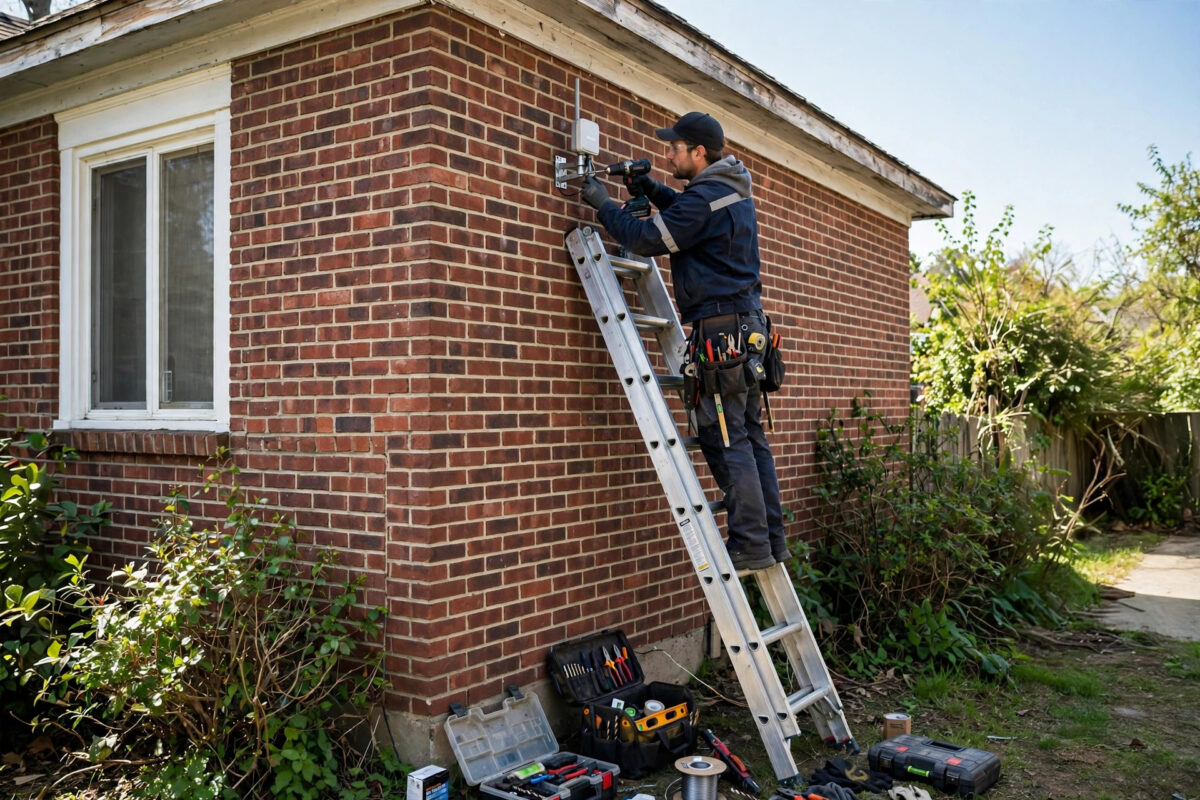
A booster (also called a repeater) has three parts: an outdoor antenna that captures the existing signal, an amplifier unit, and an indoor antenna that rebroadcasts the strengthened signal inside. Two facts follow from this design. First, a booster can only amplify what exists — if there is genuinely no usable outdoor signal at your property, a booster cannot invent one. Second, placement of the outdoor antenna is everything: a few metres higher or on the correct side of the house can double the result. If you have not yet diagnosed where your signal is lost, read our explainer on why signal disappears inside buildings first, because some homes are better served by Wi-Fi calling alone.
The UK Legal Rules in Plain Language
Ofcom changed the law to allow licence-exempt boosters that satisfy strict conditions. In plain terms, a legal home booster must:
- Boost one network’s frequencies only (single-operator devices), not every network simultaneously.
- Automatically control its power and switch features required by Ofcom’s technical specification, so it cannot interfere with the wider network.
- Be sold as compliant with the exemption — reputable UK sellers state this clearly and name the regulation.
- Be used as intended: static, in a building, serving your own premises.
Using a non-compliant repeater is an offence under the Wireless Telegraphy Act — Ofcom actively seizes illegal devices and prosecutes repeat offenders, with fines that can reach thousands of pounds. The Ofcom guidance on mobile phone repeaters is the definitive source and lists exactly which types are licence-exempt.
Choosing the Right Legal Booster
- Identify your network’s bands at your home. Your phone’s field-test screen or your network can tell you which frequency carries your signal (for example 800 MHz or 1800 MHz).
- Buy a single-operator booster matched to those bands and to your network, from a seller who states Ofcom compliance.
- Pick the coverage size honestly. Boosters are rated for indoor areas; thick-walled homes need the antenna placed centrally, not the biggest amplifier.
- Check the outdoor signal first. Stand where the antenna will go and confirm at least a stable 2–3 bars or around −95 dBm or better; below that, results disappoint.
- Budget for the full kit: antenna, amplifier, indoor antenna, and proper low-loss cable are all part of a real installation.
Installing for the Best Result
- Mount the outdoor antenna as high as practical, on the side of the house facing your network’s mast.
- Keep maximum separation — vertical and horizontal — between the outdoor and indoor antennas; too close and the system feeds back on itself, cutting power automatically.
- Point the outdoor antenna by rotating it slowly while watching a phone’s signal reading in dBm (in field test mode), not by bars.
- Place the indoor antenna centrally in the area you care about most, typically a hallway ceiling.
- Test calls in every room, then fine-tune antenna direction once more.
When a Booster Is the Wrong Answer
If your outdoor signal is effectively zero — deep valleys, very remote properties — a booster has nothing to amplify. In those locations, broadband-based solutions win: Wi-Fi calling for calls, or a home 4G/5G router with an external antenna feeding your Wi-Fi. Some networks historically offered femtocells (mini home masts running over broadband); most have been replaced by Wi-Fi calling, which is free and entirely legal everywhere.
Common Mistakes to Avoid
- Buying a cheap wideband booster from an overseas marketplace. Cheap and “works on all networks” almost always means illegal in the UK.
- Mounting antennas close together — the unit protects itself by reducing power, and coverage shrinks to almost nothing.
- Expecting a booster to fix a capacity problem. If outdoor signal is strong but slow at peak times, that is congestion, not weak signal, and a booster will faithfully amplify the congestion too.
- Forgetting other household members’ networks. A single-operator booster helps only that network — guests and family on other networks see no benefit.
What a Proper Installation Costs and Looks Like
Compliant single-network booster kits from established UK suppliers typically cost from around £250 for a small home unit to £600 or more for larger properties needing multiple indoor antennas and longer low-loss cable runs. That pricing gap versus the £60 overseas boxes is precisely the cost of the self-monitoring electronics the law requires — automatic gain control, oscillation shutdown, and network-safe power limits. A proper installation looks unremarkable: a modest antenna high on the gable or a pole, a cable run through an eaves vent or drilled entry sealed against weather, the amplifier in a loft or cupboard, and a ceiling-mounted indoor antenna that most visitors never notice. Many suppliers offer professional installation for larger homes, which also gives you a measured before-and-after in signal readings — worth requesting in writing before you pay.
Before You Buy: The Free Alternatives Checklist
- Wi-Fi calling switched on for every phone in the house.
- Your router positioned centrally, doing the indoor heavy lifting for data.
- A rival network tested indoors with a prepaid SIM — sometimes the free answer is a different SIM, not new hardware.
- Your network asked directly whether they will help; coverage teams sometimes supply approved equipment or confirm a planned mast upgrade that makes a booster unnecessary within months.
Conclusion
Legal home boosting is simple once you know the shape of the rules: one network, Ofcom-compliant equipment, a decent outdoor signal, and careful antenna placement. Do that, and a certified booster is a legitimate, effective fix for indoor dead zones. Skip the too-cheap multi-network boxes — the legal risk and interference they cause are not worth it when compliant kits and free Wi-Fi calling exist.
Frequently Asked Questions
How can I tell if a booster is legal before buying?
Look for explicit statements that the device meets Ofcom’s licence-exemption conditions for in-building repeaters, sold by a UK-based reputable retailer, and designed for a single network. Vague claims like ” Ofcom approved” with no detail, or all-network coverage, are warning signs — check the current Ofcom repeater guidance to be sure.
Will a booster improve my data speeds as well as calls?
Yes, if the slowness is caused by weak signal. A stronger signal lets your phone use faster modulation and higher bands, so data improves too. If the mast itself is congested, speeds stay limited no matter how strong the signal is.
Can I take my booster to a new house or use it in a caravan?
The exemption is written around static in-building use. Moving the kit to another fixed address and reinstalling it properly is generally acceptable; using boosters in vehicles falls under different rules, so check the current guidance before fitting one in a caravan or motorhome.
My network offered me a booster — is that legal?
Yes. Devices supplied or approved by your own network are compliant by design, and some networks still provide them to customers with proven indoor coverage problems. It is always worth asking your network before buying your own.
What happens if Ofcom finds an illegal booster at my home?
Ofcom can require the device to be switched off and seized, and using an unlicensed repeater is a criminal offence that can lead to prosecution and a substantial fine. Enforcement usually starts with investigation of interference complaints — another reason illegal units get found.


Leave a Reply