
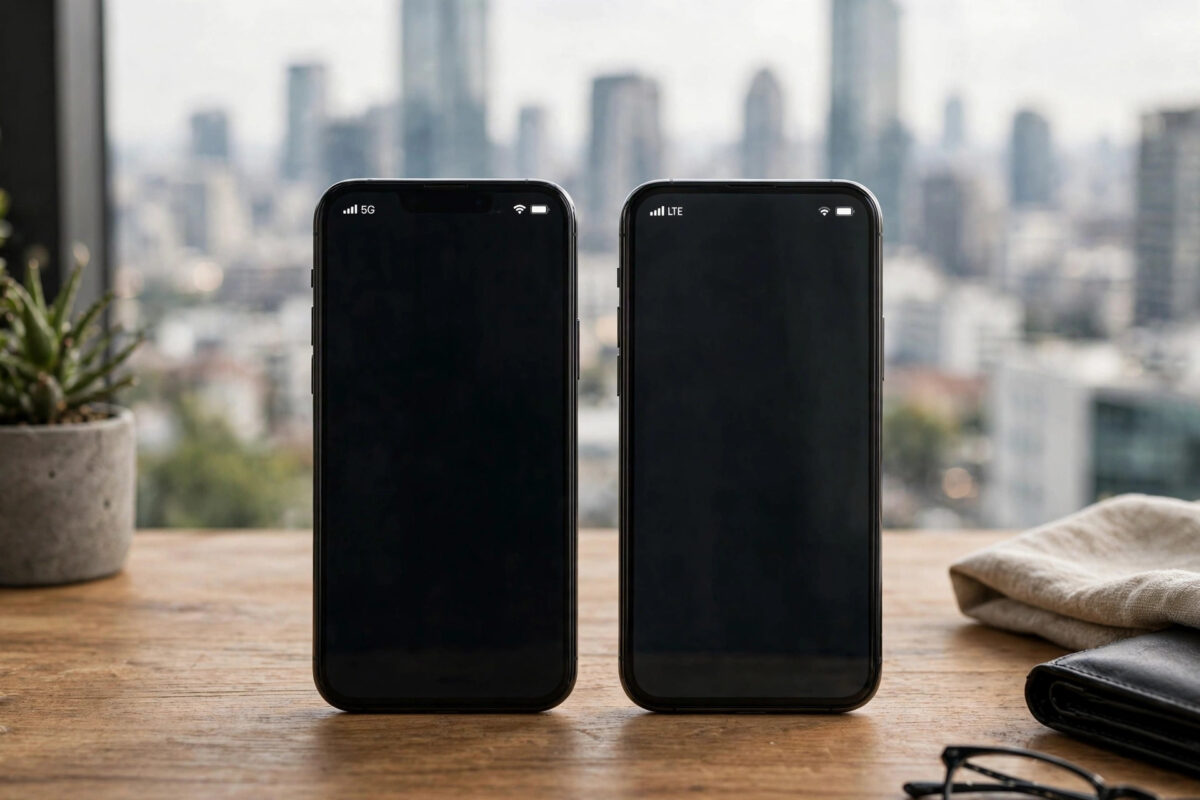
Phone screens, adverts, and network names throw around 4G, 5G, and LTE as if they were three rival technologies. In reality, LTE is the technology underneath 4G, and the confusion comes from years of marketing. Understanding what each term actually means helps you read your phone’s status bar correctly, choose the right plan, and set realistic expectations for speed. This guide explains each generation in plain language, compares their real-world speeds and features, and clears up the icons you see on your phone, including 5G UC, 5G UW, and the famous “5G E” that was not really 5G at all.
Quick Answer
LTE stands for Long Term Evolution, and it is the radio technology that powers 4G networks, so 4G and LTE are effectively the same thing in everyday use. 5G is the newer fifth generation that followed it, offering much higher speeds, far more capacity, and lower delay, especially in busy areas. If your phone shows LTE, you are on a 4G network. If it shows 5G, you are connected to the newer 5G network where coverage exists.
What Is LTE?
LTE was designed in the late 2000s as the global standard for fast mobile data. When networks first launched it, the technology did not quite meet the original technical definition of “true 4G”, so regulators allowed the marketing name 4G to be used anyway. An improved version called LTE-Advanced, and later LTE-Advanced Pro, closed the gap with faster speeds through techniques like carrier aggregation, which combines several frequency channels into one wider pipe.
In practical terms, when your phone shows “LTE”, “4G”, or “4G LTE”, it is using this same family of technology. Some phones, especially in the United States, display LTE while European phones usually display 4G. The connection is identical; only the label differs.
What Is 4G?
4G simply means the fourth generation of mobile network technology. It replaced 3G during the 2010s and made the modern smartphone era possible: smooth video streaming, social media, maps, and app downloads anywhere. Typical real-world 4G speeds range from about 10 to 60 Mbps depending on coverage and congestion, with LTE-Advanced areas reaching well above 100 Mbps in good conditions.
4G also changed how calls work. Older networks carried voice on separate 2G or 3G channels, but 4G networks use VoLTE (Voice over LTE) to carry calls as data on the 4G network itself. Our guide on what VoLTE is and how to enable it explains why this gives clearer calls and lets you browse during a call.
What Is 5G?
5G is the fifth generation, rolled out from 2019 onwards and now the standard focus of every major network in 2026. It works in three broad flavours:
- Low-band 5G travels far and passes through walls well. Speeds are a modest step above 4G, but coverage is wide, including many rural areas.
- Mid-band 5G is the sweet spot. It balances range and speed, commonly delivering 100 to 500 Mbps in towns and cities.
- High-band 5G (mmWave) is extremely fast, sometimes over 1 Gbps, but covers very short distances and is mainly found in stadiums, stations, and dense city centres in a few countries.
Beyond raw speed, 5G was designed for capacity and responsiveness. It can serve far more devices in a crowded place without slowing down, and its delay (latency) is lower, which matters for gaming, video calls, and future applications. Most current 5G runs in “non-standalone” mode, meaning it uses a 4G core network behind the scenes, while newer “standalone” 5G uses a full 5G core and unlocks the lowest latency and network slicing features.
4G LTE vs 5G: Side-by-Side Comparison
- Typical speed: 4G LTE gives roughly 10–60 Mbps in daily use. 5G commonly gives 100–500 Mbps on mid-band, and more on mmWave.
- Latency: 4G usually responds in 30–50 milliseconds. 5G typically responds in 10–25 milliseconds, lower still on standalone networks.
- Capacity: 5G handles far more simultaneous users, which is why stadium and city-centre performance has improved so much.
- Coverage: 4G LTE still covers more places overall, especially indoors and in remote areas, because it has had a decade’s head start.
- Battery use: 5G can use more battery, particularly in weak coverage where the phone works harder. Modern phones manage this much better than early 5G models did.
- Availability: Every smartphone supports 4G LTE. 5G needs a 5G phone, a fact explained in our guide on how to check if your phone supports 5G.
The GSMA, the mobile industry association, publishes accessible explainers on network generations at its 5G overview pages if you want the industry view.
Confusing Icons Explained: 5G E, 5G UC, 5G UW, and 5GE
Some status bar icons are marketing rather than engineering. “5G E” was one American network’s label for its fastest 4G LTE-Advanced network. It was not 5G at all, and the label was widely criticised. “5G UC” and “5G UW” are used by US networks to show you are on their faster mid-band or mmWave 5G rather than low-band 5G. In the UK and Europe you will simply see 5G, sometimes with no extra letters. A plain “5G” icon also does not guarantee top speed, because low-band 5G can be only slightly faster than good 4G. The icon tells you the generation, not the performance.
Does 5G Replace 4G?
Not yet, and not soon. Networks are switching off 3G to reuse its frequencies, but 4G LTE remains the backbone that fills every gap in 5G coverage, and phones fall back to it automatically. In 2026 the smartest setup is a phone that uses both: 5G where it is strong for speed and capacity, and 4G everywhere else for reliability. Your phone handles the switching itself, although occasionally it needs help, which is why some users ask why their phone keeps switching between network types when signals are weak.
Common Mistakes to Avoid
- Believing LTE is slower than 4G. They are the same network. The label depends on the phone and country, not the technology.
- Expecting maximum advertised speeds. Gigabit figures are laboratory peaks. Real speeds depend on band, distance, and congestion.
- Paying extra for 5G without coverage. Check your network’s 5G map for your home and workplace first.
- Assuming 5G E or similar labels mean real 5G. Look for a genuine 5G connection icon and a 5G plan on a 5G-capable phone.
Conclusion
LTE is the technology, 4G is the generation it belongs to, and 5G is the newer generation built for speed, capacity, and low delay. For everyday decisions, remember three things: LTE on your screen means a normal 4G connection, 5G performance depends heavily on which band you are connected to, and 4G will remain an essential fallback for years to come.
Frequently Asked Questions
Is LTE the same as 4G?
For everyday purposes, yes. LTE is the technical standard that 4G networks are built on. Phones in some countries display LTE and in others display 4G for the exact same connection.
Why does my 5G sometimes feel slower than 4G?
You are probably on low-band 5G with a weak signal, or the 5G cell is busy. In those cases a strong 4G connection nearby can genuinely be faster. Moving position or letting the phone choose automatically usually fixes it.
Will 4G phones stop working when 5G spreads?
No. Networks plan to run 4G for many years alongside 5G. It is 3G (and eventually 2G) being switched off, not 4G.
What is LTE-Advanced?
It is an upgraded version of LTE that combines multiple frequency channels and uses smarter antennas to reach much higher speeds. Many networks market it as 4G+ and phones show a 4G+ icon in covered areas.
Do I need a new SIM for 5G?
Usually your existing 4G SIM works for 5G if your plan includes 5G access, but very old SIMs can cause problems. If 5G never appears on a 5G phone and plan, ask your provider for a free SIM swap.


[…] show how these bands fit into global network plans if you want the wider picture. Our comparison of the difference between 4G, 5G, and LTE explains how these pieces fit […]