
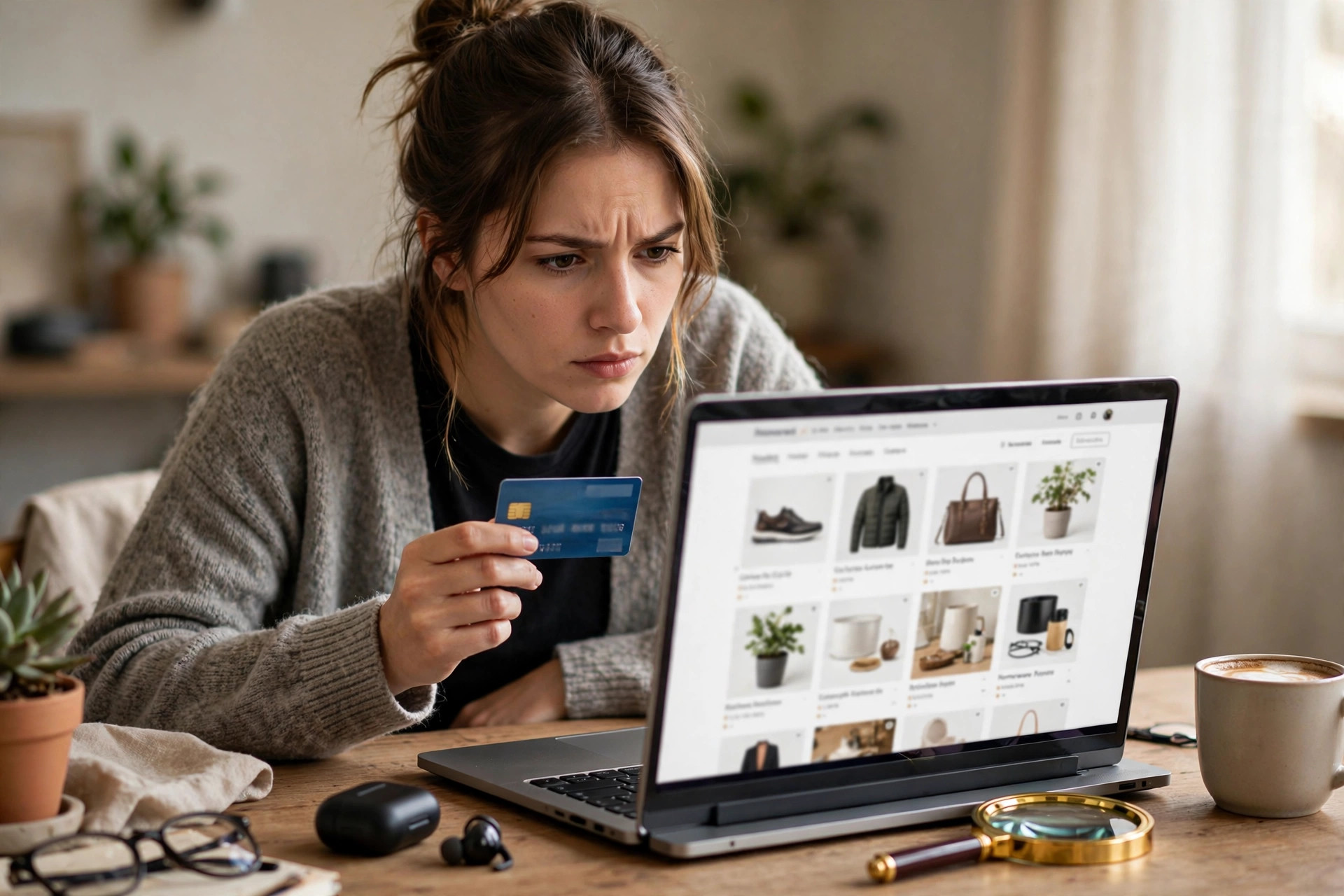
Fake online stores have become polished, convincing, and fast. Many copy real product photos, run paid adverts on social media, and disappear within weeks, taking payment details and personal information with them.
The good news is that scam shops almost always leave clues. Learning to spot them takes only a few minutes per purchase, and those minutes can save you money, stress, and a compromised bank card.
This guide walks through the checks professionals use before paying any unfamiliar store, from the website address to the returns policy, so you can shop new brands with confidence.
Quick Answer
Check the domain age and spelling, look for a real address and returns policy, and search the store name plus the word scam or reviews.
If prices are far below everywhere else, payment is by bank transfer only, and there is no way to contact a real person, do not pay.
Start With the Website Address
The address bar tells you more than most shoppers realise. Fake stores often use names that imitate famous brands with one letter changed, an extra word, or an unusual ending.
Read the domain slowly, character by character. A familiar logo means nothing if the address itself is a lookalike created last month to harvest orders.
Check How Old the Domain Is
Most scam stores are brand new. A shop claiming years of happy customers but registered a few weeks ago is contradicting itself in a way you can verify.
You can look up registration dates with a free WHOIS search. Age alone does not prove honesty, because legitimate new businesses exist, but a very new domain should raise your caution and trigger every other check in this guide.
Also look for the padlock and HTTPS. That only means the connection is encrypted, not that the business is honest. Scam sites use HTTPS too, so treat it as a minimum, never as proof.
Investigate the Business Behind the Site
A real store is a real business with a traceable footprint. A fake one is usually just a checkout page with stock text copied from somewhere else.
Search for a physical address, a company registration, and a working phone number. Then test them rather than simply noting that they exist. Our wider online safety and privacy guides cover this kind of verification for other services too.
- Copy the store’s stated address and search it on a maps service to see what is actually there.
- Search the business name separately from its own website and read independent results.
- Call or message the contact details and judge whether a real support person responds helpfully.
- Check whether the same address and phone number appear on dozens of unrelated stores, a common scam pattern.
- Look for the business on official company registers where your country provides them.
If every path leads back to the store’s own pages and nowhere else, you are looking at a business with no history. That is a strong reason to pause.
Read the Policies Most Shoppers Skip
Scam stores invest in product pages and neglect the boring pages. That neglect is one of your best detection tools.
Open the returns, shipping, privacy, and terms pages. Vague promises, missing timeframes, no return address, and text full of grammar errors borrowed from another shop all point the same way.
Returns and Refunds Deserve Special Attention
A legitimate retailer explains who pays return postage, how long refunds take, and where items go back to. Fake stores often promise easy returns, then reveal an expensive overseas address only after you complain.
Be especially wary if returns must go to a different country from the one the store pretends to be based in. That mismatch is rarely explained honestly upfront.
The guidance from the Federal Trade Commission on safer online shopping makes the same point: understand a seller’s terms before money changes hands, not after a problem starts.
Scrutinise Prices, Products, and Photos
Scammers compete on fantasy pricing. A designer item at eighty percent off, in every size, with no catch, is not a bargain strategy. It is bait.
Compare the price with the brand’s own store and two or three established retailers. A small discount is normal competition. A dramatic gap needs a believable explanation, such as a clearance line or refurbished stock, clearly stated.
Reverse-Check the Images
Fake stores steal photography. Right-click or save a product image and run a reverse image search to see where it appeared first.
If the same photo sells the same product under five different store names, you are looking at copied listings. Genuine small brands may use supplier photos, but they will still have consistent branding and their own details elsewhere.
Also watch the reviews on the product page itself. Hundreds of five-star comments with similar wording, no dates, and no critical reviews at all usually means the store wrote them.
Look for Independent Reviews and Warnings
Never judge a store only by what it says about itself. Independent voices are where fake shops are usually exposed first.
- Search the store name together with words like scam, reviews, and not delivered.
- Check established review platforms and read the recent one-star reviews in detail.
- Look for warnings from consumer groups, local news, or the brand being imitated.
- Search social media for real customers posting delivery photos or complaints.
- Be suspicious if every positive review appeared in the same short burst of days.
A new legitimate store may have few reviews, and that alone is not damning. A store surrounded by consistent complaints about non-delivery is a different matter entirely.
Pay in a Way That Protects You
Even after careful checks, choose a payment method with a way back. How you pay decides whether a mistake costs you an afternoon or your savings.
Credit cards and reputable payment services usually offer dispute and chargeback processes. Bank transfers, gift cards, and crypto payments are very hard to reverse, which is exactly why scammers push them.
- Use a credit card or a trusted payment service with buyer protection where possible.
- Never complete a purchase that moves you off the store to pay by direct transfer.
- Avoid saving your card details on an unfamiliar store for future orders.
- Keep the confirmation email, order number, and screenshots until the goods arrive.
- Check your bank statement in the days after ordering for unexpected extra charges.
If a store offers a further discount for paying by transfer, treat that offer itself as a warning sign. Legitimate retailers do not need to steer you away from protected payments.
Common Mistakes Shoppers Make
The most common mistake is trusting professional design. Building a beautiful scam site is cheap now, so appearance tells you almost nothing about honesty.
Another is assuming an advert on a major platform was vetted. Adverts are largely automated, and scam stores advertise widely precisely because the reach works.
Shoppers also rush under countdown timers and low-stock warnings. Those pressure tactics are usually scripts, not real stock levels, and they exist to stop you doing the checks in this guide.
Finally, many people ignore their instincts after investing time choosing an item. Walking away from a basket costs nothing. Paying the wrong store can cost a great deal.
Conclusion
Recognising a fake online store is a skill built from small, quick checks: read the domain, verify the business, read the returns policy, question impossible prices, and search for independent reviews.
Then protect yourself a second time by paying with a method that lets you dispute the charge. Spend three minutes checking before you pay, and unfamiliar stores become far less risky to buy from.
Frequently Asked Questions
Does a padlock icon mean an online store is genuine?
No. The padlock means the connection is encrypted. Scam sites use encryption too, so you still need to verify the business, its policies, and its reputation.
How can I tell if store reviews are fake?
Look for repeated phrases, all five stars, no specific product details, and reviews posted in a tight cluster of dates. Then compare with reviews on independent platforms.
Is it safe to buy from a store I found through a social media advert?
It can be, but the advert itself is no guarantee. Run the same domain, business, and returns checks you would use for any unfamiliar shop before paying.
What should I do if I already paid a fake store?
Contact your bank or card provider immediately, explain the situation, and ask about disputing the charge. Change any password you reused and monitor your statements closely.
Are very cheap prices always a sign of a scam?
Not always, because sales and clearance stock exist. But prices far below every competitor, on every item, with no clear reason, should always trigger extra checks.
Leave a Reply