
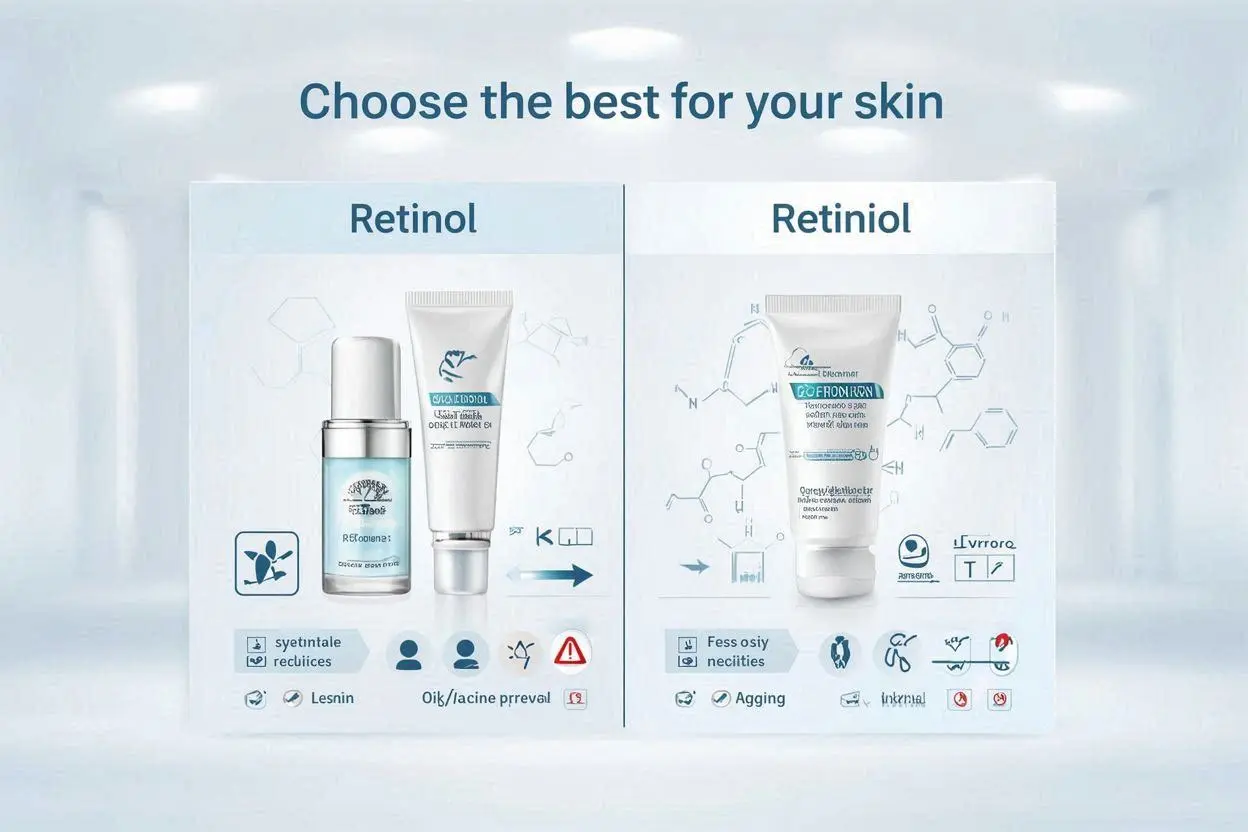
Many people feel confused when they hear the words retinol and retinoid. They sound similar, and many brands use them in different ways. But the truth is simple: they are connected, but they are not the same.
If you understand the difference, you can choose the right product for your skin. This will help you save money, avoid irritation, and get better results.
This guide will explain everything in very easy words, step by step.
What Is Retinol vs Retinoid?
What Are Retinoids?
Retinoids are a group (or family) of ingredients made from Vitamin A. These are used in skincare to improve many skin problems.
They help with:
- Wrinkles
- Acne
- Dark spots
- Uneven skin tone
- Rough skin texture
Retinoids include different types like:
- Retinol
- Retinaldehyde
- Tretinoin
- Adapalene
So, retinoid is the big category.
What Is Retinol?
Retinol is just one type of retinoid.
It is:
- Weaker than most other retinoids
- Available without a prescription
- Gentle on the skin
- Good for beginners
So remember this simple rule:
Retinol is a retinoid, but not all retinoids are retinol.
Easy Example to Understand
Think of it like this:
- Retinoid = Fruit
- Retinol = Apple
All apples are fruit, but not all fruit are apples.
That’s exactly how retinol and retinoids work.
How Retinol and Retinoids Work on Skin
The Important Thing You Should Know
Your skin cannot use retinol directly.
First, it has to change (convert) into a stronger form called retinoic acid.
This happens in steps:
- Retinol → Retinaldehyde
- Retinaldehyde → Retinoic Acid
Only retinoic acid works directly on skin cells.
Why This Matters
Because of this process:
- Retinol works slowly
- Retinol is gentle
- Retinoic acid works fast
- Retinoic acid is strong
This is the main difference between them.
Retinol vs Retinoic Acid (Simple Comparison)
Retinol
- Needs time to convert
- Works slowly
- Less irritation
- Good for beginners
- Available without prescription
Retinoic Acid (like Tretinoin)
- Works immediately
- Strong and powerful
- Can irritate skin
- Needs prescription
- Faster results
Benefits of Retinol for Skin
Retinol is one of the most popular skincare ingredients because it is gentle and effective.
Main Benefits
1. Reduces Fine Lines and Wrinkles
- Boosts collagen in skin
- Makes skin look younger
2. Improves Skin Texture
- Smoothens rough skin
- Makes skin soft
3. Fades Dark Spots
- Helps reduce pigmentation
- Makes skin tone even
4. Helps with Acne
- Keeps pores clean
- Reduces breakouts
5. Adds Glow
- Skin looks fresh and healthy
Who Should Use Retinol?
Retinol is best for:
- Beginners
- People with sensitive skin
- Mild acne
- Early signs of aging
Benefits of Strong Retinoids
Stronger retinoids are usually given by doctors. These work faster and give more visible results.
Main Benefits
1. Treats Moderate to Severe Acne
- Clears deep acne
- Prevents new breakouts
2. Reduces Deep Wrinkles
- Works deeper in the skin
- Improves aging signs faster
3. Improves Sun Damage
- Repairs damaged skin
- Brightens dull skin
4. Treats Stubborn Pigmentation
- Helps with melasma
- Works on dark patches
5. Faster Skin Renewal
- Removes old skin cells quickly
- Reveals fresh skin
Who Should Use Retinoids?
- People with severe acne
- Deep wrinkles
- Strong pigmentation
- Those who want fast results
Key Differences Between Retinol and Retinoids
Strength
- Retinol = Mild
- Retinoids = Strong
Speed
- Retinol = Slow results
- Retinoids = Fast results
Irritation
- Retinol = Low
- Retinoids = High
Availability
- Retinol = Over-the-counter
- Retinoids = Prescription
How to Choose the Right One
Choosing the right product depends on your skin.
Choose Retinol If:
- You are a beginner
- You have sensitive skin
- You want slow but safe results
- You are scared of irritation
Choose Retinoids If:
- You have severe acne
- You want fast results
- You have deep wrinkles
- You are okay with some irritation
Best Way to Start Using Retinol or Retinoids
Start slow. This is very important.
Step-by-Step Guide
Week 1–2
- Use 2 times a week
Week 3–4
- Use every other night
After 1 Month
- Use daily (if skin is okay)
How to Apply Properly
Follow these simple steps:
- Wash your face
- Wait for skin to dry completely
- Take a pea-sized amount
- Apply gently on face
- Use moisturizer after
Important Safety Tips
Always Follow These Rules
- Use only at night
- Always wear sunscreen in the morning
- Do not use too much product
- Avoid mixing with strong acids at the start
- Be patient
Common Side Effects
When you start using retinol or retinoids, your skin may react.
This is normal.
Possible Effects
- Redness
- Dryness
- Peeling
- Slight burning feeling
This usually improves after a few weeks.
Mistakes to Avoid
Many people make these mistakes:
- Using too much product
- Using it daily from day one
- Not using sunscreen
- Mixing with strong exfoliants
- Expecting fast results
Avoid these to protect your skin.
How Long Does It Take to See Results?
Be patient.
Timeline
- 2–4 weeks: Skin adjustment phase
- 6–8 weeks: Small improvements
- 8–12 weeks: Visible results
- 3–6 months: Best results
Consistency is the key.
Can You Use Retinol with Other Products?
Yes, but carefully.
Safe Combinations
- Moisturizer
- Hyaluronic acid
- Niacinamide
Avoid at the Beginning
- Strong acids (AHA, BHA)
- Scrubs
- Vitamin C (use at different time)
Retinol for Different Skin Types
Dry Skin
- Use low strength
- Always use moisturizer
Oily Skin
- Helps control oil
- Start slowly
Sensitive Skin
- Use very low strength
- Apply less often
Acne-Prone Skin
- Helps reduce breakouts
- Start gently
Retinol Myths You Should Ignore
Myth 1: Retinol gives instant results
Truth: It takes time
Myth 2: More product works better
Truth: Small amount is enough
Myth 3: You can skip sunscreen
Truth: Sunscreen is a must
Myth 4: Retinol is only for aging
Truth: It also helps acne and texture
Final Thoughts
Now you clearly understand the difference between retinol and retinoids.
- Retinol is gentle and perfect for beginners
- Retinoids are stronger and give faster results
Start slow, stay consistent, and protect your skin with sunscreen every day.
Good skincare is not about speed. It is about patience and regular use.
Frequently Asked Questions
What is the main difference between retinol and retinoids?
Retinol is a mild type of retinoid. Retinoids are stronger and include many forms of Vitamin A.
Can retinol damage skin?
If used correctly, it is safe. Overuse can cause dryness and irritation.
How often should I use retinol?
Start 2–3 times a week, then slowly increase.
Can beginners use retinoids?
Strong retinoids are not ideal for beginners. Start with retinol first.
Do I need sunscreen with retinol?
Yes, always. Your skin becomes sensitive to sunlight.
Can I use retinol every night?
Only after your skin gets used to it.
Which is better for acne?
Retinoids are stronger for acne, but retinol also helps mild acne.
When should I start using retinol?
You can start in your mid-20s for prevention or earlier for acne.
Can I use retinol with moisturizer?
Yes, it is highly recommended.
Why is my skin peeling?
This is normal in the beginning. It will improve with time.


Be First to Comment