
Imagine you’re cruising down the highway, enjoying your favorite playlist, when suddenly you hear that dreaded thump-thump-thump. Your tire has gone flat. Panic sets in—do you call for help, or handle it yourself? Knowing how to change a tire can turn a stressful roadside emergency into a quick fix, saving you time, money, and frustration.
In the U.S. alone, the American Automobile Association (AAA) responds to over 30 million roadside assistance calls annually, with flat tires accounting for a significant portion—around 2 million cases each year. Yet, many drivers admit they’ve never changed a tire before. This skill isn’t just for mechanics; it’s essential for every driver, from daily commuters to long-haul adventurers.
This comprehensive guide walks you through how to change a tire safely and efficiently. We’ll cover everything from basic tools to advanced techniques, including tips for different vehicles like cars, trucks, and SUVs. Whether you’re a beginner facing your first flat or an experienced driver seeking pro-level insights, you’ll find actionable advice here. By the end, you’ll feel confident tackling this common issue. Let’s dive in and empower you to hit the road with peace of mind.
(For more on vehicle maintenance basics, check out our guide on tire pressure monitoring systems.)
Understanding Flat Tires: Causes, Signs, and Prevention
Before learning how to change a tire, it’s crucial to understand why flats happen. A flat tire occurs when air escapes rapidly, often due to punctures, wear, or damage. Common causes include nails, potholes, improper inflation, or even extreme weather cracking the rubber.
Spot the signs early: A sudden vibration, pulling to one side, or the low-pressure warning light on your dashboard signals trouble. Ignoring these can lead to blowouts, which are dangerous at high speeds.
Prevention is key. Regularly check tire pressure—aim for the PSI recommended in your owner’s manual, typically 30-35 PSI for passenger cars. Rotate tires every 5,000-8,000 miles to ensure even wear. Statistics from the National Highway Traffic Safety Administration (NHTSA) show that underinflated tires contribute to over 11,000 crashes yearly in the U.S.
Tip: Invest in a tire pressure gauge and use it monthly. For advanced users, consider run-flat tires, which allow driving up to 50 miles at reduced speeds after a puncture. Pros: Enhanced safety; cons: Higher cost and stiffer ride.
By preventing flats, you reduce the need to change a tire roadside. But when it happens, preparation makes all the difference.
(Explore our article on preventing common car breakdowns for more preventive tips.)
Essential Tools and Equipment for Changing a Tire
You can’t master how to change a tire without the right tools. Most vehicles come with a basic kit, but upgrading ensures efficiency and safety.
Start with the essentials:
- Spare Tire: Check it’s inflated and in good condition. Full-size spares match your regular tires; compact “donuts” are temporary.
- Jack: Hydraulic or scissor jacks lift the vehicle. Pros of hydraulic: Easier lifting; cons: Bulkier.
- Lug Wrench: A cross-shaped tool for loosening lug nuts. Torque wrenches for advanced users ensure proper tightening (usually 80-100 ft-lbs).
- Wheel Chocks: Blocks to prevent rolling.
Additional must-haves: Flashlight, gloves, reflective vest, and a tire inflator. For rainy days, a poncho keeps you dry.
Example: On a Ford F-150 truck, the jack is stored under the rear seat, while the spare hangs underneath. Always consult your manual for specifics.
Pro Tip: Assemble a roadside emergency kit with these items. It could save your life—NHTSA reports that 500+ fatalities occur annually during roadside repairs due to poor visibility.
With tools ready, you’re set to learn the core process of changing a tire.
(Link to our buyer’s guide on best roadside emergency kits for recommendations.)
Safety First: Preparing Your Vehicle and Surroundings
Safety overrides speed when figuring out how to change a tire. A single mistake can lead to injury or accidents.
Pull over to a flat, stable surface away from traffic. Turn on hazard lights and place reflective triangles 50-100 feet behind your vehicle.
If on a highway, exit if possible. Never change a tire on a slope or soft ground—the jack could slip.
Engage the parking brake and shift to park (automatic) or first gear (manual). For front-wheel drive cars, chock the rear wheels; reverse for rear-wheel drive.
Personal safety: Wear gloves to avoid grease and a vest for visibility. If it’s dark, use your phone’s flashlight or a headlamp.
Statistic: According to the Federal Highway Administration, over 700 people die yearly in roadside incidents. Don’t become one—call for help if conditions feel unsafe.
Advanced Insight: In electric vehicles like Teslas, disable the air suspension before jacking to prevent damage.
Prepared? Now, let’s get to the step-by-step guide on how to change a tire.
Step-by-Step Guide: How to Change a Tire on a Car
This section breaks down how to change a tire into simple, actionable steps. Follow them precisely for success.
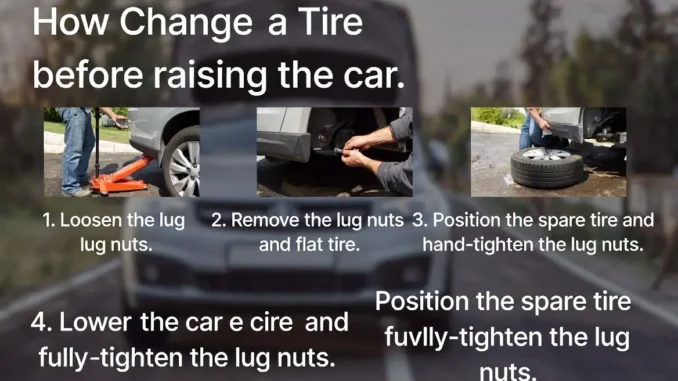
Step 1: Loosen the Lug Nuts
Before lifting, loosen the lug nuts while the tire is on the ground—it provides resistance.
Use the lug wrench to turn counterclockwise. Apply body weight if they’re tight, but don’t remove them yet.
Tip: If rusted, spray WD-40 and wait 5 minutes. For stubborn nuts, a breaker bar extends leverage.
Example: On a Honda Civic, lug nuts are typically 19mm—know your size to avoid stripping.
Step 2: Position and Use the Jack
Locate the jack points—reinforced areas under the frame, marked in your manual.
Place the jack and lift slowly until the flat tire is 1-2 inches off the ground. Never go under the vehicle.
Pro Tip: For SUVs, use a higher-capacity jack to handle the weight.
Step 3: Remove the Flat Tire
Fully unscrew lug nuts and set them aside. Grip the tire by the treads and pull straight off. It might stick—gently rock it.
Place the flat under the vehicle as a safety backup if the jack fails.
Step 4: Mount the Spare Tire
Align the spare’s holes with the wheel bolts. Push it on firmly.
Hand-tighten lug nuts in a star pattern to ensure even seating.
Step 5: Lower the Vehicle and Tighten Lug Nuts
Lower the jack until the tire touches the ground, then tighten lug nuts fully in the star pattern.
Use a torque wrench for precision—overtightening can warp rotors.
Step 6: Final Checks and Cleanup
Stow tools and the flat tire. Check spare pressure—donuts often need 60 PSI.
Drive slowly (under 50 mph for donuts) to a tire shop for repair or replacement.
Congratulations! You’ve just learned how to change a tire. Practice in your driveway to build confidence.
(For vehicle-specific guides, see our post on changing tires on trucks.)
Also read: i Square – Lenovo EX: Revolutionizing Technology with Innovation Squared and Extended Experiences
How to Change a Tire on Different Vehicles: Adaptations for Trucks, SUVs, and More
The basics of how to change a tire apply universally, but variations exist.
For trucks like the Chevy Silverado: Spares are often under the bed—use the provided rod to lower it. Heavier weight requires a sturdy jack.
SUVs: Higher ground clearance eases access, but ensure stability on uneven terrain.
Motorcycles: Use a center stand or paddock stand. Remove the axle nut, then the wheel.
Electric cars: Avoid jacking near batteries. Tesla models have specific lift points.
Pros of knowing adaptations: Versatility; cons: More tools needed for specialized vehicles.
Tip: For all-wheel-drive cars, match spare size to avoid differential damage.
Example: Changing a tire on a Jeep Wrangler involves removing the rear-mounted spare—simple but exposed to elements.
Master these for any ride.
(Link to electric vehicle maintenance tips.)
Common Mistakes When Changing a Tire and How to Avoid Them
Even pros err when learning how to change a tire. Avoid these pitfalls.
Mistake 1: Forgetting to loosen lug nuts first—leads to spinning wheels mid-air.
Solution: Always loosen on the ground.
Mistake 2: Incorrect jack placement—can bend the frame or cause slips.
Solution: Use manual-designated points.
Mistake 3: Overtightening—strips threads.
Solution: Torque to specs.
Statistic: Improper jacking causes 20% of roadside injuries, per safety reports.
Advanced Tip: Use anti-seize on lug nuts to prevent future rust.
By dodging these, your tire changes stay smooth.
Advanced Tips and Techniques for Efficient Tire Changes
Take how to change a tire to the next level with these pro strategies.
Use an impact wrench for speed—battery-powered models loosen nuts in seconds. Pros: Time-saving; cons: Risk of overtorquing without care.
Inflate spares with portable compressors plugged into your car’s outlet.
For off-roaders: Carry tire plugs for quick puncture fixes without full changes.
Example: Racers use air jacks for ultra-fast swaps, but for everyday, a floor jack offers stability.
Incorporate TPMS reset—many cars require it post-change.
These tips elevate your skills from basic to expert.
(For tool upgrades, read best impact wrenches for auto work.)
Tire Maintenance After Changing: Repairs, Replacements, and Long-Term Care
Changing a tire is step one; maintenance follows.
Assess the flat: Punctures under 1/4 inch in the tread can often be patched for $20-30.
Replace if sidewall damaged—irreparable.
Balance and align new tires to prevent uneven wear.
Tip: Rotate every oil change. NHTSA data shows proper maintenance extends tire life by 20%.
Pros of timely repairs: Cost savings; cons: Delaying leads to blowouts.
Keep spares rotated into use occasionally.
This ensures your tires last.
(Link to tire rotation schedules.)
Environmental and Cost Considerations in Tire Changing
How to change a tire impacts more than your wallet—consider the environment.
Recycle old tires; many shops do it free. Improper disposal contributes to 300 million scrapped tires yearly in the U.S., per EPA.
Cost-wise: DIY saves $100+ vs. towing. But invest in quality spares—cheap ones fail faster.
Green Tip: Choose eco-friendly tires with low rolling resistance for better fuel efficiency.
Pros: Savings and sustainability; cons: Higher upfront costs.
Balance both for smart driving.
Special Scenarios: Changing a Tire in Bad Weather or at Night
Weather complicates how to change a tire.
In rain: Use a tarp under the jack for grip. Work quickly to avoid hypothermia.
At night: Illuminate with multiple lights. Wear reflective gear.
Snow: Clear ice; use chains if needed post-change.
Example: In a desert, heat exhaustion looms—hydrate and work in shade.
Advanced: Carry thermal blankets in your kit.
Preparation turns challenges into manageables.
(Link to winter driving safety.)
When to Call Professionals: Knowing Your Limits
Sometimes, DIY isn’t best for how to change a tire.
If the spare is flat, lug nuts seized, or you’re injured, call AAA or a tow.
For run-flats, professional tools are often needed.
Statistic: 40% of drivers prefer pros for safety, per surveys.
Pros of calling: Expertise; cons: Wait times.
Know when to seek help—it’s smart, not weak.
Conclusion: Empower Yourself on the Road
Mastering how to change a tire equips you with independence and safety. From spotting flats to advanced adaptations, this guide covers it all. Remember: Prepare tools, prioritize safety, follow steps, and maintain tires ongoing.
Practice today—grab your manual and simulate a change. You’ll thank yourself next time trouble strikes. Drive safe, and stay empowered.
For more automotive know-how, explore our roadside safety essentials.
FAQ: Common Questions About How to Change a Tire
1. How long does it take to change a tire?
For beginners, 15-30 minutes; pros do it in under 10. Factors like rust or vehicle type affect time.
2. Can I drive far on a spare tire?
Compact spares limit you to 50 miles at 50 mph max. Full-size spares allow normal driving but get repaired soon.
3. What if my car doesn’t have a spare tire?
Many modern cars use tire inflator kits. Learn to use them, or carry a spare kit.
4. How much does it cost to change a tire professionally?
Roadside service: $50-150. Shop repair: $20 for patches, $100+ for new tires.
5. Is it safe to change a tire on the highway?
Only if necessary—pull far off, use hazards, and consider calling help for high-traffic areas.
6. How do I know if my jack is strong enough?
Check its rating against your vehicle’s weight. Most car jacks handle 2-3 tons; trucks need more.

Leave a Reply