
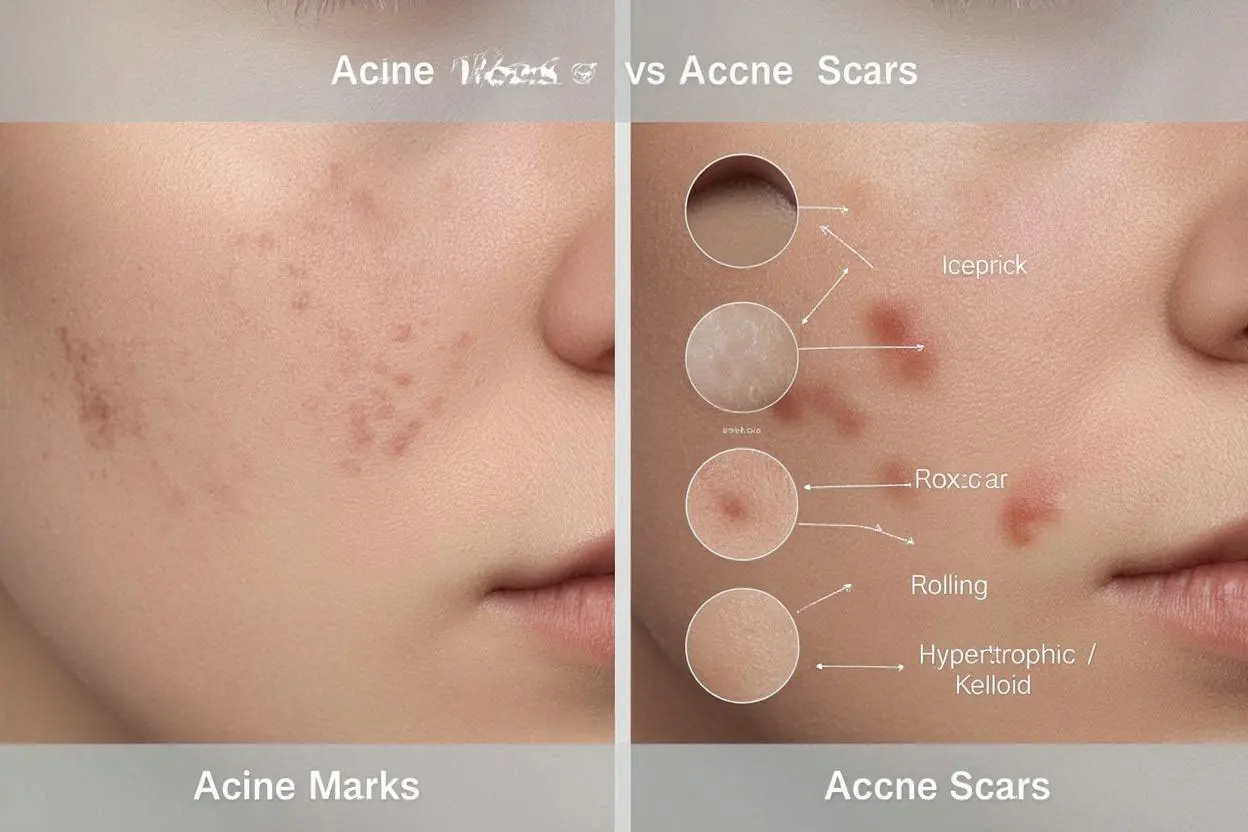
When your acne finally goes away, it often leaves something behind—dark spots, red patches, or uneven skin texture. Most people immediately think: “I have acne scars.”
But that’s not always true.
In many cases, what you’re seeing are not scars at all—they are acne marks, which are temporary and can fade with time and proper care. True acne scars, on the other hand, are permanent changes in skin texture.
Understanding the difference is very important because treatment for marks and scars is completely different. If you treat them the wrong way, you may waste time and money without seeing results.
This guide will help you clearly identify what you have, how to treat it, and what results you can realistically expect.
What Are Acne Marks?
Acne marks are flat skin discolorations that appear after a pimple heals. They do not damage the structure of your skin. Instead, they are just leftover pigment or redness.
The good news?
👉 Acne marks usually fade on their own with time.
There are two main types:
1. Post-Inflammatory Hyperpigmentation (PIH)
PIH appears as:
- Brown spots
- Dark grey patches
- Sometimes almost black marks
Why it happens:
When your skin gets inflamed from acne, it produces extra melanin (skin pigment). This leaves behind dark spots after healing.
Who gets it more:
- Medium to darker skin tones
How long it lasts:
- Usually 3 to 12 months
Does it fade?
Yes, slowly—especially with sunscreen and brightening skincare.
2. Post-Inflammatory Erythema (PIE)
PIE appears as:
- Pink marks
- Red patches
- Light purple spots
Why it happens:
It is caused by damaged or widened blood vessels after acne inflammation.
Who gets it more:
- Lighter skin tones
How long it lasts:
- Can last weeks to several months
Does it fade?
Yes, but it may need targeted treatments if persistent.
What Are Acne Scars?
Acne scars are permanent changes in skin texture caused by damage deep in the skin during severe acne.
Unlike marks, scars are not just on the surface—they affect collagen, the structure that keeps skin smooth.
Key sign:
👉 If you can feel it, it’s likely a scar.
Types of Acne Scars
1. Atrophic (Depressed) Scars
These are indentations or “holes” in the skin.
- Icepick scars: small, deep holes (like pinpricks)
- Boxcar scars: wider dents with sharp edges
- Rolling scars: wave-like uneven skin
2. Hypertrophic & Keloid Scars (Raised)
These occur when the skin produces too much collagen.
- Thick raised bumps
- Often found on chest, back, jawline
- More common in body acne
Read: 19 Types of Ear Piercings Explained
Acne Marks vs Acne Scars: How to Tell the Difference
If you are confused, use these simple checks:
1. Touch Test
- Smooth skin → Acne mark
- Uneven or bumpy skin → Acne scar
2. Look Test
- Brown, red, or pink flat spots → Marks
- Dents or raised areas → Scars
3. Time Test
- Fades in months → Mark
- Stays for years → Scar
Simple Rule:
✔ If it’s flat and discolored → MARK
✔ If it has texture (indent or bump) → SCAR
Key Differences Between Acne Marks and Acne Scars
| Feature | Acne Marks | Acne Scars |
|---|---|---|
| Skin issue | Pigment or blood vessels | Collagen damage |
| Appearance | Flat discoloration | Textured (raised or dented) |
| Touch | Smooth | Uneven |
| Cause | Inflammation | Deep skin damage |
| Fade naturally | Yes | No or very limited |
| Treatment | Skincare products | Professional procedures |
Acne Scars vs Hyperpigmentation (Common Confusion)
Many people think hyperpigmentation is a scar—but it’s not.
Hyperpigmentation (PIH):
- Only affects skin color
- Flat brown/dark marks
- No texture change
Acne Scars:
- Affect skin structure
- Cause dents or raised areas
- Permanent without treatment
👉 Important: One acne breakout can cause both at the same time.
Do Acne Scars Go Away?
This is the most common question.
Honest answer:
- Most acne scars do NOT go away naturally
However:
- They can improve significantly with treatment
- Some become less visible over time
- Early treatment gives better results
What doesn’t fade easily:
- Deep icepick scars
- Boxcar scars
- Keloid scars
👉 Waiting usually does not fix scars—treatment does.
What Causes Acne Scars?
Several factors increase scarring risk:
- Picking or squeezing pimples
- Severe inflammation
- Delayed acne treatment
- Genetics
- Repeated breakouts in same area
👉 The deeper the acne, the higher the chance of scarring.
Professional Treatments for Acne Scars
When skincare is not enough, dermatological treatments help.
1. Microneedling
- Tiny needles create micro-injuries
- Boosts collagen production
- Smooths skin texture over time
Best for:
- Rolling scars
- Mild boxcar scars
2. Laser Treatments
- Removes damaged skin layers
- Stimulates new collagen growth
Best for:
- Deep scars
- Uneven texture
3. Subcision
- Breaks scar tissue under skin
- Lifts depressed scars
Best for:
- Deep rolling scars
4. Chemical Peels
- Removes top damaged layer of skin
- Helps fade dark marks
Best for:
- PIH (dark spots)
- Mild surface issues
5. Dermal Fillers
- Fill sunken scars instantly
- Temporary but fast results
Best for:
- Deep boxcar scars
At-Home Treatments for Acne Marks
Home care works best for marks, not deep scars.
For Dark Marks (PIH)
- Sunscreen SPF 30+ daily
- Vitamin C serum
- Retinoids
- Niacinamide
- AHAs (glycolic acid)
👉 Results take 6–12 months.
For Red Marks (PIE)
- Gentle skincare
- Moisturizer for barrier repair
- Sunscreen
- Avoid harsh exfoliation
Important Rule:
✔ Consistency matters more than expensive products
Prevention: How to Avoid Scars and Marks
Prevention is always easier than treatment.
Best habits:
- Never pick pimples
- Treat acne early
- Use non-comedogenic products
- Apply sunscreen daily
- Avoid harsh scrubs
- Keep skincare simple and consistent
👉 Every pimple has the potential to become a mark or scar.
Simple Acne-Safe Skincare Routine
Morning:
- Gentle cleanser
- Vitamin C or niacinamide
- Lightweight moisturizer
- Sunscreen SPF 30+
Night:
- Gentle cleanser
- Retinoid (slow introduction)
- Moisturizer
Weekly:
- Mild exfoliation (2–3 times max)
Final Conclusion
The most important thing to understand is this:
👉 Not all acne damage is a scar
If it is a mark:
- It will fade
- Use skincare + sunscreen
- Be patient
If it is a scar:
- It will not fully disappear on its own
- You may need professional treatment
- Earlier treatment = better results
Golden rule:
The best way to avoid both marks and scars is controlling acne early and not picking your skin.
Clear skin is not just about treatment—it’s about prevention, patience, and consistency.

Be First to Comment