
Ear piercings have become one of the most popular ways to express personal style. From a simple stud in the earlobe to a full “curated ear” with multiple designs, people are now treating ears like a fashion canvas.
But when you start exploring options, it can get confusing:
What is a helix?
How painful is a daith?
Which piercing heals fastest?
And what should you avoid as a beginner?
This guide explains everything in very simple words. You’ll learn all 19 types of ear piercings, their pain levels, healing time, safety tips, and aftercare in a clear, natural flow.
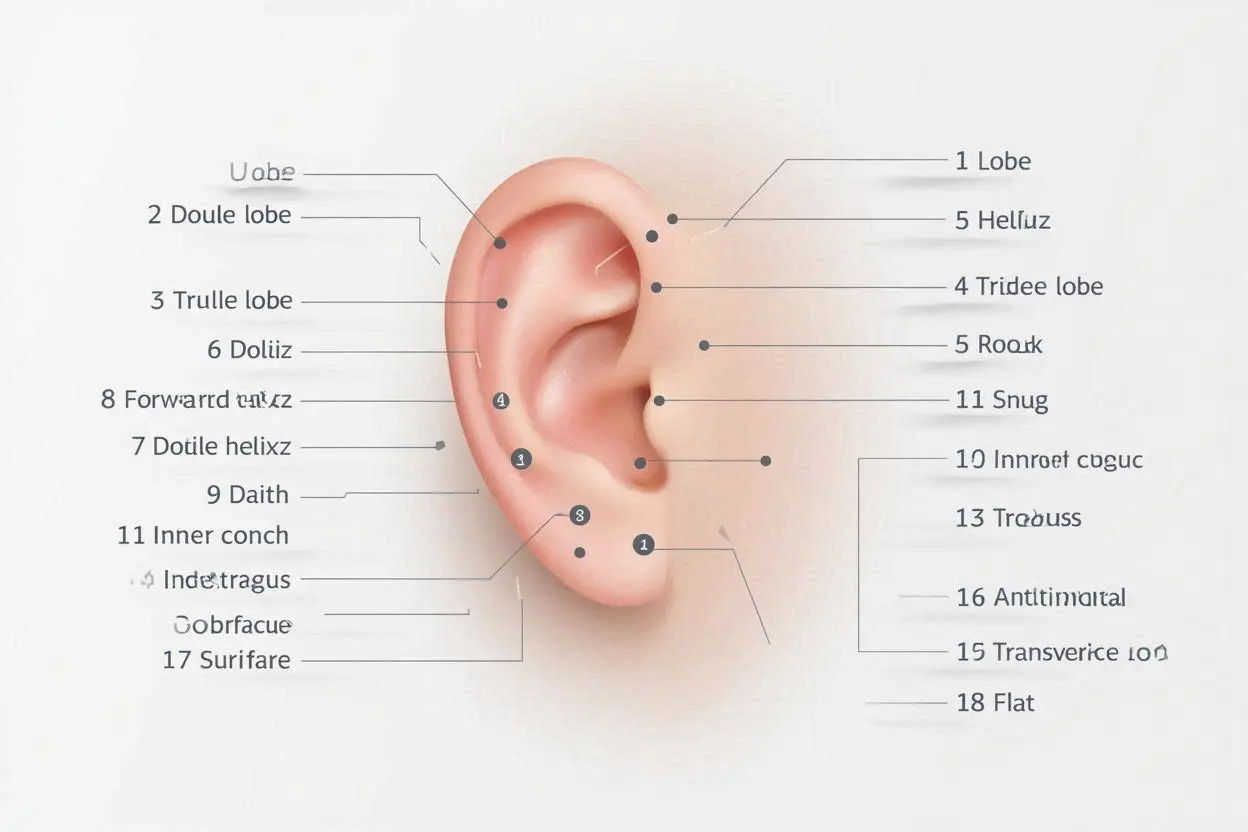
Quick Understanding: Ear Structure
Before understanding piercings, you need to know ear parts in simple terms.
Your ear has two main areas:
1. Earlobe (Soft Part)
- Bottom soft part of your ear
- No cartilage
- Least painful to pierce
- Heals fastest
👉 This is why most people start here.
2. Cartilage (Hard Part)
- Upper and middle ear structure
- Firm, not soft
- Slower healing
- Slightly more painful
Cartilage includes:
- Helix (outer rim)
- Forward helix (front upper rim)
- Tragus (small flap near ear canal)
- Conch (center bowl area)
- Rook, daith, anti-tragus, etc.
💡 Simple rule:
Soft = easy + fast healing
Cartilage = slower + more care needed
19 Types of Ear Piercings (Explained Simply)
1. Standard Lobe Piercing
- Pain: Very low (1–2/10)
- Healing: 6–8 weeks
This is the most basic and common piercing. It goes through the soft bottom part of your ear.
✔ Best for beginners
✔ Fast healing
✔ Least painful
2. Upper Lobe (Second Lobe)
- Pain: Low
- Healing: 6–12 weeks
This is just above the first lobe piercing. You can stack multiple lobe piercings here.
✔ Great for layered earring looks
3. Stretched Lobe (Gauged)
- Pain: Mild (slow stretching process)
- Healing: Ongoing (weeks between sizes)
This involves slowly enlarging the hole using plugs.
✔ Bold fashion statement
⚠ Must be done slowly to avoid tearin
4. Transverse Lobe
- Pain: Medium (4–6/10)
- Healing: 2–10 months
A bar goes horizontally through the lobe instead of front-to-back.
✔ Unique and rare look
5. Helix Piercing
- Pain: Medium (4–5/10)
- Healing: 6–9+ months
Done on the outer upper rim of the ear.
✔ Very popular
✔ Looks good with hoops or studs
6. Forward Helix
- Pain: Medium (5/10)
- Healing: 3–9 months
Placed on the front upper rim of the ear.
✔ Can be single, double, or triple piercings
7. Flat (Scapha) Piercing
- Pain: Medium-high (5–7/10)
- Healing: 6–12 months
Done on the flat area between helix and inner ear.
✔ Perfect for decorative jewelry
Read: Mandelic Acid Benefits
8. Auricle (Mid Helix)
- Pain: Medium (3–5/10)
- Healing: 3–9 months
Located in the middle outer rim of ear.
✔ Subtle but stylish
9. Industrial Piercing
- Pain: High (6–8/10)
- Healing: 6–12 months
Two holes connected with one long bar.
✔ Bold and edgy look
⚠ Needs careful aftercare
10. Tragus Piercing
- Pain: Medium (5–6/10)
- Healing: 3–9 months
Done on the small flap near your ear canal.
✔ Very stylish and visible
11. Surface Tragus
- Pain: Medium-high
- Healing: 6–12 months
A surface bar sits on top instead of going through cartilage.
⚠ Higher rejection risk
12. Anti-Tragus
- Pain: High (6/10)
- Healing: 9–12 months
Opposite side of tragus near lobe.
⚠ Not everyone has enough anatomy for it
13. Rook Piercing
- Pain: High (6–7/10)
- Healing: 6–12 months
Done on inner cartilage fold.
✔ Hidden but stylish
14. Snug Piercing
- Pain: Very high (8–9/10)
- Healing: 6–12+ months
Inner ridge of ear cartilage.
⚠ One of the most painful piercings
15. Daith Piercing
- Pain: Medium-high (5–6/10)
- Healing: 6–9 months
Inner fold above ear canal.
✔ Popular myth: migraine relief (not scientifically proven)
16. Inner Conch Piercing
- Pain: Medium-high (5–7/10)
- Healing: 3–9 months
Middle bowl-shaped area of ear.
✔ Great for large studs or hoops
17. Outer Conch Piercing
- Pain: Medium-high
- Healing: 3–9 months
Outer edge of the conch area.
✔ Stylish hoop placements after healing
18. Orbital Lobe Piercing
- Pain: Low-medium (3–5/10)
- Healing: 6–10 weeks
Two lobe holes connected with one hoop.
✔ Unique “double hole ring” effect
19. Orbital Cartilage Piercing
- Pain: Medium-high (4–6/10)
- Healing: 6–12 months
Same idea but in cartilage.
⚠ Needs expert piercer
Pain Level Summary
- Low Pain: Lobe, Orbital lobe
- Medium Pain: Helix, Tragus, Conch
- High Pain: Rook, Snug, Industrial
💡 Important: Pain is temporary, healing is long-term.
Healing Time Overview
- Earlobe: 6–8 weeks
- Cartilage: 3–12 months
👉 Cartilage takes longer because blood flow is low.
Safe Piercing Rules (Very Important)
Always do this:
✔ Go to a professional piercer
✔ Ask for sterile needle (NOT gun)
✔ Use titanium or gold jewelry
Never do this:
❌ Don’t use piercing guns
❌ Don’t touch with dirty hands
❌ Don’t change jewelry early
Aftercare Guide (Simple & Effective)
1. Don’t Touch It
Touching can cause infection.
2. Clean with Saline
Use sterile salt water 2–3 times daily.
3. Avoid Sleeping on It
Use a travel pillow if needed.
4. Don’t Twist Jewelry
Let it heal naturally.
5. Be Patient
Cartilage takes months, not weeks.
Common Problems (And Solutions)
1. Swelling
✔ Normal in first days
✔ Use saline cleaning
2. Pain after days
⚠ Could be pressure or infection
3. Bumps
✔ Usually irritation, not serious
4. Infection signs
⚠ Yellow discharge, heat, strong pain → see doctor
Final Thoughts
Ear piercings are not just fashion—they are personal expression. From simple lobe piercings to advanced cartilage designs, every style has its own personality.
If you are a beginner, start with lobe or helix. If you want bold style, try industrial or conch.
FAQs About Ear Piercings
1. Which ear piercing hurts the least?
Lobe piercing is the least painful.
2. Which piercing takes longest to heal?
Snug and industrial piercings take the longest.
3. Can I sleep on a new piercing?
No, avoid pressure during healing.
4. Are cartilage piercings permanent?
Yes, once healed they stay unless removed.
5. Can I get multiple piercings at once?
Yes, but healing becomes harder.
6. What is the safest piercing metal?
Titanium and solid gold are safest.
7. Do daith piercings help migraines?
No strong scientific proof exists.

Leave a Reply