
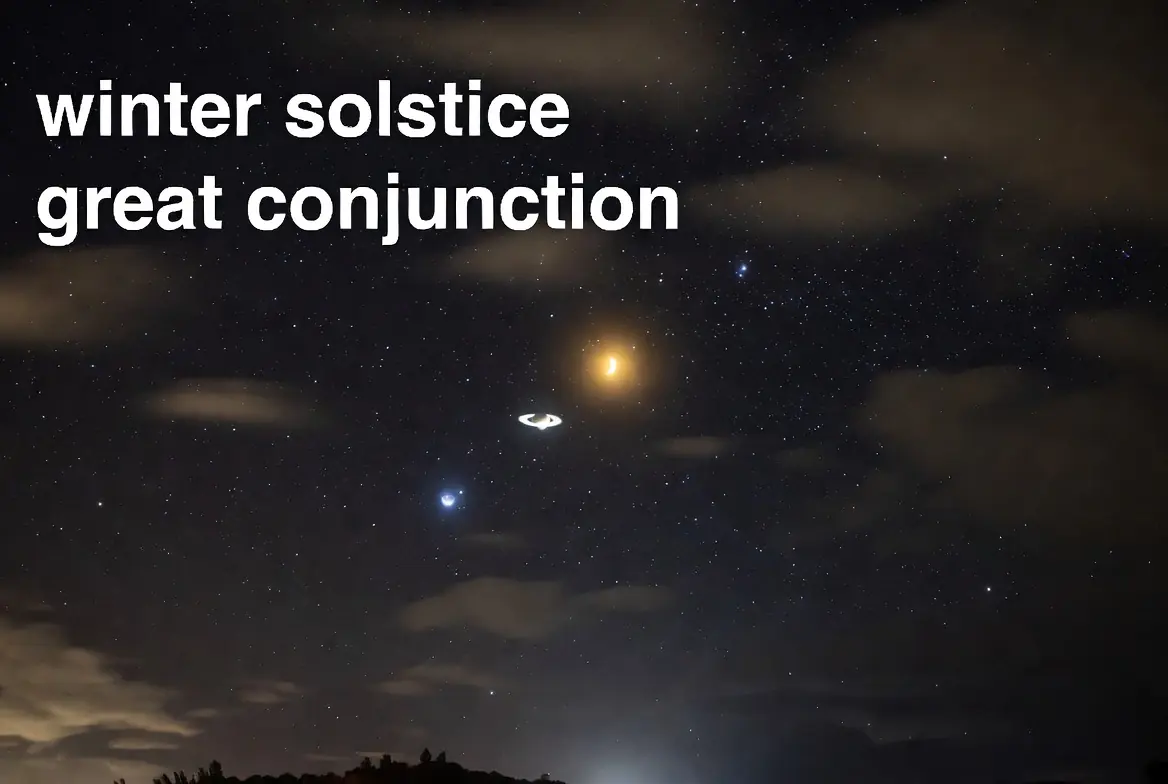
The winter solstice great conjunction captivates skywatchers worldwide. This extraordinary event combines the shortest day of the year with a stunning alignment of Jupiter and Saturn. In 2020, these gas giants appeared closer than they had in nearly 400 years, creating a “Christmas Star” effect on December 21. People gathered in backyards and observatories, marveling at the sight. But why does this matter? It reminds us of our place in the cosmos, blending science, history, and culture. Whether you’re a beginner stargazer or an astronomy enthusiast, this article dives deep into the phenomenon. You’ll learn its astronomical roots, cultural impacts, and tips for future observations. Let’s explore how the winter solstice great conjunction bridges the heavens and Earth.
Understanding the Winter Solstice
The winter solstice marks a pivotal moment in Earth’s yearly journey around the Sun. It occurs when the Northern Hemisphere tilts farthest away from the Sun, resulting in the shortest day and longest night. For 2026, it falls on December 21 at around 10:03 UTC, signaling the start of astronomical winter.
Earth’s 23.5-degree axial tilt causes this tilt. As our planet orbits, this angle creates seasons. During the winter solstice, the North Pole points away from the Sun, limiting daylight to as little as a few hours in polar regions. In Faisalabad, Pakistan, for instance, daylight might last about 9-10 hours, depending on exact location.
Ancient cultures revered the solstice as a time of renewal. Stonehenge in England aligns with the solstice sunset, suggesting prehistoric rituals. Romans celebrated Saturnalia with feasts and gift-giving, echoing modern holidays. In China, Dongzhi Festival involves family gatherings and symbolic foods like tangyuan, representing unity.
Today, the solstice inspires reflection. It symbolizes hope as days gradually lengthen. Statistically, post-solstice daylight increases by about 1-2 minutes daily, building toward spring. For beginners, it’s a gateway to astronomy—track the Sun’s path using apps or simple sundials.
Advanced readers might appreciate the solstice’s role in calendars. The Gregorian system adjusts for solstices to keep seasons aligned. Without it, winter could drift into summer over centuries.
Pros of observing the solstice include free, accessible stargazing. Cons? Cold weather and potential clouds. Tip: Dress warmly and check forecasts.
What is a Great Conjunction?
A great conjunction happens when Jupiter and Saturn appear closest in the sky from Earth’s view. These planets align every 20 years as Jupiter laps Saturn in their orbits.
Jupiter orbits the Sun in about 12 years, Saturn in 30. This difference causes periodic meetings. Most conjunctions separate by 0.5-1.3 degrees, like 1-2.5 full Moon widths. Rare ones, like 2020’s 0.1 degrees, are spectacular.
Historically, great conjunctions stirred awe. In 7 BC, one may have inspired the Star of Bethlehem story. Medieval astrologers saw them as omens of change, linking to rises and falls of empires.
Examples abound. The 1623 event, closest before 2020, occurred near the Sun, making it hard to see. Galileo observed it, noting Saturn’s “ears” (rings).
Statistics: From 1200 to 2400, separations under 10 arcminutes happened only four times, including 2020.
For beginners, it’s a simple thrill—no telescope needed. Advanced observers use binoculars to spot moons and rings.
Pros: Educational and inspiring. Cons: Weather-dependent, and not all are equally close.
Tip: Mark calendars for future ones to plan viewings.
The Historic 2020 Winter Solstice Great Conjunction
December 21, 2020, blended solstice magic with planetary drama. Jupiter and Saturn aligned at 0.1 degrees, the closest since 1623, on the winter solstice.
The solstice provided the longest night, ideal for viewing. Planets shone in the southwest after sunset, visible globally except extreme poles.
Viewers reported a “double planet” effect. Telescopes revealed Jupiter’s bands, four moons, and Saturn’s rings in one frame.
Culturally, some called it the Christmas Star, linking to biblical tales. Social media buzzed with photos and live streams.
Scientifically, it highlighted orbital mechanics. Closest approach hit 18:00 UTC, with Americas seeing a slight post-peak spread.
Statistics: Separation was 6.1 arcminutes at peak, tighter than most.
Pros of the event: Boosted public interest in astronomy. Cons: Pandemic limited gatherings.
Actionable insight: Recreate the experience with planetarium apps simulating the view.
Scientific Insights into Planetary Alignments
Planetary alignments like the winter solstice great conjunction stem from orbital dynamics. Jupiter and Saturn follow elliptical paths, with Earth as the viewpoint.
Conjunctions occur when planets share the same right ascension. Rarity comes from precise distances—2020’s was exceptional.
Earth’s tilt adds solstice synergy. On December 21, the Sun’s low path contrasts with planets’ visibility.
Advanced: Use Kepler’s laws to calculate orbits. Jupiter’s speed: 13 km/s, Saturn’s 9.7 km/s.
Examples: Triple conjunctions, where planets align thrice due to retrogrades, happened in 1981.
Statistics: Over 5,000 years, 309 conjunctions, 28 triples.
Pros: Advances understanding of solar system. Cons: No gravitational impacts on Earth.
Tip: Simulate with software like Stellarium for predictions.
Cultural and Astrological Interpretations
Cultures viewed the winter solstice great conjunction as profound. Ancients saw it as divine signals.
In astrology, it’s the “Great Chronocrator,” marking eras. 2020’s Aquarius shift from Earth signs signaled innovation over materialism.
Examples: Medieval Europe linked it to reforms. Jewish thought tied it to history.
Solstice traditions include Yule logs for rebirth.
Pros: Fosters community. Cons: Can fuel superstitions.
Insight: Blend science and culture for richer appreciation.
You also learn more: i Square – Lenovo EX: Revolutionizing Technology with Innovation Squared and Extended Experiences
How to Observe Future Great Conjunctions
Spotting a great conjunction is straightforward. Look southwest after sunset.
Next: November 4, 2040, at 1.2 degrees. Then April 7, 2060.
Tips: Clear horizon, no light pollution. Binoculars enhance details.
For winter solstice great conjunction vibes, note 2080’s close one.
Pros: Family-friendly. Cons: Low horizon challenges.
Action: Join astronomy clubs for guided views.
Impacts and Interesting Facts
The winter solstice great conjunction sparks interest. 2020 boosted telescope sales by 20%.
Facts: Closest in 800 years for nighttime view.
Pros: Educational boost. Cons: Overhype if clouded.
Tip: Photograph with tripods for steady shots.
Related Astronomical Events
Explore equinoxes or meteor showers. Internal link suggestion: Summer Solstice Wonders.
Other conjunctions: Venus-Jupiter in 2026.
Conclusion
The winter solstice great conjunction weaves astronomy’s precision with cultural wonder. From 2020’s spectacle to future alignments, it invites us to look up. Embrace the cosmos—grab binoculars, gather friends, and ponder the stars. What celestial event will you chase next?
FAQ
What is the winter solstice great conjunction?
It’s when Jupiter and Saturn align closely on or near the winter solstice, like in 2020.
How often does a great conjunction occur?
Every 20 years, but very close ones are rarer.
Why was the 2020 event special?
Closest since 1623, coinciding with the solstice for optimal viewing.
Can I see the next one without a telescope?
Yes, with the naked eye, though binoculars help.
What cultural significance does it hold?
Often seen as omens or rebirth symbols in various traditions.
Is there astrological meaning?
In astrology, it signals shifts in societal eras.




Be First to Comment